


Comparing Depictions of the Boston Massacre

Compare and Contrast
Share to Google Classroom
Recommended Activity
Published By:
National Archives Foundation
Historical Era:
Revolution and the New Nation (1754-1820s)
Thinking Skill:
Historical Analysis & Interpretation
Bloom’s Taxonomy:
Analyzing
Grade Level:
Upper Elementary, Middle School
Suggested Teaching Instructions
This activity can be used in a unit that explores the events that led to the American Revolution. For grades 4-8.
Before beginning the activity, organize students into small groups. Ask students what the word massacre means. Ask students to take 30 seconds to read the word silently and write down any thoughts or words that come to mind. Student groups should then take a few minutes to discuss their words and thoughts and write a shared definition.
Share a dictionary definition of the word massacre:
- Massacre: an indiscriminate and brutal slaughter of people: the attack was described as a cold-blooded massacre.
- Synonyms: slaughter, killing, annihilation, extermination, mass execution, liquidation, elimination; to butcher, to kill, to mow down, to cut down, to put to death, to wipe out
Based on the definition and discussion, ask students:
- What qualifies a historic event to be defined and remembered as a massacre?
- Who decides on calling such events massacres?
Explain to students that they will review a variety of documents about the “Boston Massacre.” Explain to the class that there were different points of view on this event. Provide students with the following facts and background information on the Boston Massacre.
- The Boston Massacre was a conflict between British troops stationed in Boston and colonial dockworkers.
- The event occurred on March 5, 1770, on King Street in Boston.
- Five people died and six were injured.
- The event was called the “Bloody Massacre” by the colonists, and “An Unhappy Disturbance” by the British.
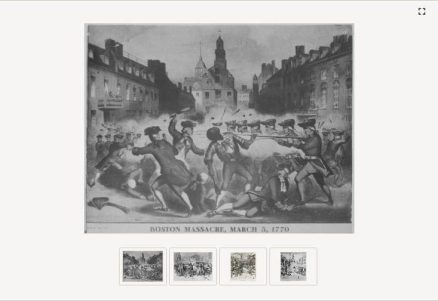
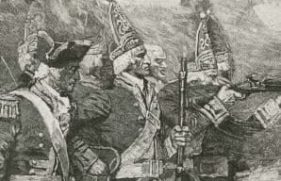
Divide the class into groups of three. Each group member should open the student activity and focus their analysis on a different depiction of the Boston Massacre from the mid-1800s, answering the questions:
- Use the image to summarize what you think happened during the Boston Massacre.
- Based on the image, which group seems to be the aggressor (person starting or provoking the attack)?
- Do you think the image depicts the viewpoint of the colonists involved or that of the British soldiers? Explain your opinion.
After analyzing their individual images, students should discuss their image with the other group members, sharing what they think happened based on the perspective of their document. Then, as a group, they should compare the images:
- Do the documents portray the same story of the Boston Massacre? Why or why not?
- What are the similarities and differences between the documents?
Once they have discussed their images, each group should click “When You’re Done” to answer the final questions. They will focus their attention on the final image in the series – a contemporaneous depiction, Paul Revere’s engraving The Bloody Massacre, from March 1770. Explain to students that The Bloody Massacre was the one of the only depictions of the massacre that most colonists saw outside of Boston. It was distributed widely through newspapers, the main source of information at the time.
Define propaganda for the students as “exaggerated information used to influence the opinion of others,” and explain that Paul Revere’s version of the Boston Massacre has widely been viewed as Patriot propaganda for the American Revolution.
Ask students to compare and contrast the first three images to the fourth image, Paul Revere’s contemporaneous The Bloody Massacre from March 1770:
- Does Paul Revere’s portrayal of the event seem to show a bias? Why or why not?
- How do you think colonists have reacted to this image? Why?
- Do you think that Paul Revere’s depiction of the Boston Massacre qualifies as propaganda? Why or why not?
This activity was adapted from “Boston Massacre” and “Identifying Bias: Boston Massacre” in the the New York City Department of Education’s Passport to Social Studies, Grade 7, Unit 2, Lessons 7-8 (pg. 89-104).

To the extent possible under law, National Archives Foundation has waived all copyright and related or neighboring rights to “Comparing Depictions of the Boston Massacre”
Description
In this activity, students will examine and analyze several artistic depictions of what is commonly called the Boston Massacre of March 5, 1770.
Share this activity with your students
Documents in this Activity

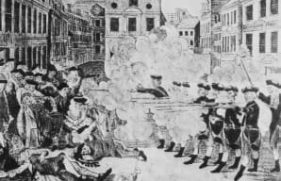
The Bloody Massacre Perpetrated in King Street, Boston on March 5th 1770 by a Party of the 29th Reg
Revolution and the New Nation (1754-1820s)