

Comparing and Contrasting Oaths of Allegiance

Compare and Contrast
Share to Google Classroom
Recommended Activity
Published By:
National Archives Foundation
Historical Era:
Revolution and the New Nation (1754-1820s)
Thinking Skill:
Historical Analysis & Interpretation
Bloom’s Taxonomy:
Analyzing
Grade Level:
Middle School, High School
Suggested Teaching Instructions
This activity is intended to be used in a unit focused on the the American Revolution. For grades 6-12. Approximate needed time is 20 minutes.
Before beginning the activity, organize students into small groups. Ask students what the words oath and allegiance mean. Ask students to take 30 seconds to read the words silently and write down any thoughts or words that come to mind. Student groups should then take a couple of minutes to discuss their words and thoughts and write a shared definition.
Share a dictionary definition of the words oath and allegiance:
- Oath
- a serious promise that you will do what you have said
- a public pledge that a person will perform some action or duty
- statement of fact or a promise taken by a person
- oaths often have a religious connection
- Allegiance
- loyalty and support for a ruler, country, group, or belief
- the act of binding yourself to a course of action
Based on the definitions and discussion, ask students:
- When do people take oaths?
- Why is it required that people take an oath in these situations?
- When have you been asked to show allegiance?
Examples of oaths may include when providing testimony in a court case, becoming a US citizen, taken by members of the military or public employees when beginning their employment, taken by doctors, taken by people when they are married, etc. And students will likely mention the Pledge of Allegiance as an example of being asked to show allegiance.
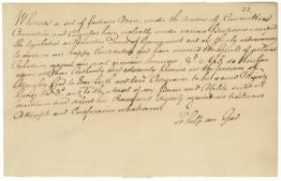
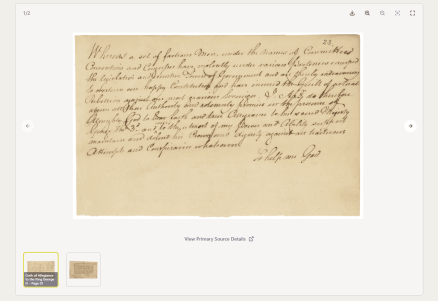
Explain to students that they will review a two oaths from the early part of the American Revolution–one from a loyalist perspective and one from a patriot perspective. They will be comparing and contrasting the two documents for style, tone, audience and overall message.
After discussing the specific similarities and differences, direct students to the “When You’re Done” and the following questions:
- What specifically does each oath promise the oath-taker will do?
- How does the oath describe the people of the colonies and the colonies themselves?
- How does the oath describe King George III?
Discuss their answers and provide the following historical context, if necessary.
This document shows the oath of allegiance signed by George Washington, Commander in Chief of the Armies of the United States of America, while encamped at Valley Forge, PA, on May 12, 1778. Oaths of allegiance and fidelity and oaths of office were taken mainly by Continental Army line and staff officers in accordance with a resolution of the Continental Congress of February 3, 1778. The oaths generally included the name of the subscriber, his rank or office, his organization, the date, the name and rank of the witness, and the place where the oath was taken.
The National Archives has oaths of allegiance signed by such figures as Alexander Hamilton, Marquis de Lafayette, Nathanael Greene, and infamously Benedict Arnold.

To the extent possible under law, National Archives Foundation has waived all copyright and related or neighboring rights to “Comparing and Contrasting Oaths of Allegiance”
Description
In this activity students will analyze the language of two oaths of allegiance. One oath unsigned from the Virginia State papers from a loyalist perspective. The other oath signed by George Washington at Valley Forge in May 1778. Students will compare and contrast these two documents for style, tone, audience and message focusing particular attention on how the oaths describe the colonies and King George III.
Share this activity with your students
Documents in this Activity
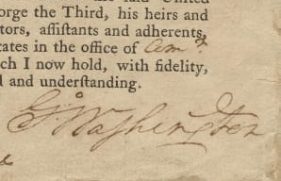
George Washington's Oath of Allegiance
Revolution and the New Nation (1754-1820s)