

Comparing and Contrasting Declarations

Compare and Contrast
Share to Google Classroom
Recommended Activity
Published By:
National Archives Foundation
Historical Era:
Across Eras: Civics & Government
Thinking Skill:
Historical Analysis & Interpretation
Bloom’s Taxonomy:
Analyzing
Grade Level:
High School
Suggested Teaching Instructions
This activity is intended to be used in a unit focused on the mid-19th century reform era, the suffrage movement, and or women’s studies. For grades 6-12. Approximate needed time is 45 minutes.
Before beginning the activity, organize students into small groups. Ask students what it means to declare something or make a declaration. Ask students to take 30 seconds to read the word silently and write down any thoughts or words that come to mind. Student groups should then take a few minutes to discuss their words and thoughts and write a shared definition.
Share a dictionary definition of the word declare (or declaration):
- Declare: formally and explicitly state or announce publicly.
Synonyms: proclaim, announce, state, assert. - Declaration: something stated formally or officially; written announcement or proclamation.
Synonyms: announcement, statement, proclamation, pronouncement.
Based on the definition and discussion, ask students:
- What does it mean to declare something (or make a declaration) as opposed to simply stating it?
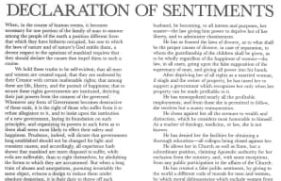
Share the following section of the Declaration of Sentiments.
We hold these truths to be self-evident; that all men and women are created equal; that they are endowed by their Creator with certain inalienable rights; that among these are life, liberty, and the pursuit of happiness; that to secure these rights governments are instituted, deriving their just powers from the consent of the governed.
Ask them to identify this selection. If students mention the Declaration of Independence, explain that this is from the Declaration of Sentiments, a document written in 1848 that was modeled extensively on the Declaration of Independence. In fact, in the selection shared the only major difference (outside of some punctuation) is the inclusion of the words and women into the text. Based on that distinction, ask students to predict what topics they think the Declaration of Sentiments might include.
Ask students to recall their prior knowledge about the Declaration of Independence.
- What are some of the key words or phrases that we associate with the Declaration of Independence?
- What was the purpose of the Declaration of Independence?
- Who was the intended audience?
- How was the Declaration of Independence organized?
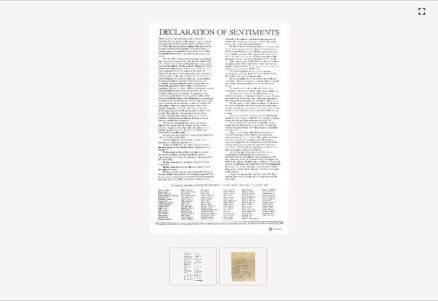
After discussing their prior knowledge, direct students in small groups to read the Declaration of Sentiments (referring back to the Declaration of Independence as needed). As they read, they should focus on comparing and contrasting the two documents.
- Compare and contrast the intended purpose of the Declaration of Sentiments with the Declaration of Independence?
- Compare and contrast the intended audience of the Declaration of Sentiments with the Declaration of Independence?
- Compare and contrast the tone and message of the Declaration of Sentiments with the Declaration of Independence?
- What are the major grievances offered in both the Declaration of Independence and Declaration of Sentiments? What are the major similarities and differences between these types of grievances?
- Compare and contrast the goals and desired outcomes of the Declaration of Sentiments and the Declaration of Independence?
After discussing these questions, direct students to click on “When You’re Done” and lead a class discussion on the following:
- Why do you think Elizabeth Cady Stanton modeled the Declaration of Sentiments’ language and structure so directly on the Declaration of Independence? If she wrote a similar declaration but less tied to the Declaration of Independence, would it have been more or less effective? Explain.
- Did the passage of the 19th amendment to the US Constitution which granted suffrage (or the right to vote) to women fulfill the goals of the Declaration of Sentiments? Why or why not?
Share the following historical context, if necessary:
Declaration of Independence
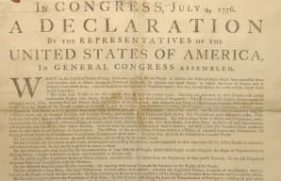
On June 7, 1776, Virginian delegate Richard Henry Lee introduced a resolution to members of the Continental Congress “that these united colonies are and of right ought to be free and independent states.” They appointed a Committee of Five to write an announcement explaining the reasons for independence. Thomas Jefferson wrote the first draft.
On June 11, 1776, Jefferson holed up in his Philadelphia boarding house and began to write. He borrowed freely from existing documents like the Virginia Declaration of Rights and incorporated accepted ideals of the Enlightenment. Less than three weeks after he’d begun, he presented his draft to Congress.
On July 2, 1776, Congress voted to declare independence. Two days later, after some edits to Jefferson’s draft, it ratified the text of the Declaration. John Dunlap, official printer to Congress, worked through the night to set the Declaration in type and print approximately 200 copies.
Declaration of Sentiments
The Declaration of Sentiments was written at the first women’s rights convention in American history at Seneca Falls, New York, in 1848. Organized by Elizabeth Cady Stanton, Lucretia Mott, and other women’s rights and anti-slavery activists, the meeting attracted more than 300 participants including abolitionist Frederick Douglass.
Chiefly written by Elizabeth Cady Stanton, the language of the Declaration of Sentiments is heavily influenced by the Declaration of Independence. Sixty-eight women and 32 men signed the Declaration of Sentiments in 1848.
Over seven decades later suffragist, Carrie Chapman Catt declared, “It took George Washington six years to rectify men’s grievances by war, but it took 72 years to establish women’s rights by law.” Only one woman present at Seneca Falls—Charlotte Woodward—lived to see the ratification of the 19th Amendment in 1920.
The location of the original Declaration of Sentiments is unknown.
For additional materials related to Comparing and Contrasting Declarations (including Guiding Questions, National Standards, Historical Background and Supplemental Educational Resources).

To the extent possible under law, National Archives Foundation has waived all copyright and related or neighboring rights to “Comparing and Contrasting Declarations”
Description
In this activity students will analyze the language of the Declaration of Independence (1776) and the Declaration of Sentiments (1848). Students will compare and contrast these two documents for style, tone, audience and message.
Share this activity with your students
Documents in this Activity
Dunlap Broadside
Revolution and the New Nation (1754-1820s)