

Compare and Contrast Oaths of Allegiance

Compare and Contrast
Share to Google Classroom
Recommended Activity
Published By:
National Archives Foundation
Historical Era:
Revolution and the New Nation (1754-1820s)
Thinking Skill:
Historical Analysis & Interpretation
Bloom’s Taxonomy:
Analyzing
Grade Level:
Middle School, High School, College/University
Suggested Teaching Instructions
Today, examples of taking oaths may include when providing testimony in a court case, becoming a US citizen, by members of the military or public employees when beginning their employment, by doctors, and by people when they are married. Students might mention the Pledge of Allegiance as an example of being asked to show allegiance. Share with students the dictionary definition of the words oath and allegiance:
Oath
- a serious promise that you will do what you have said
- a public pledge that a person will perform some action or duty
- statement of fact or a promise taken by a person
Allegiance
- loyalty and support for a ruler, country, group, or belief
- the act of binding yourself to a course of action
Based on the definitions, ask students to discuss:
- When do people take oaths?
- Why is it required that people take an oath in these situations?
- When have you been asked to show allegiance?
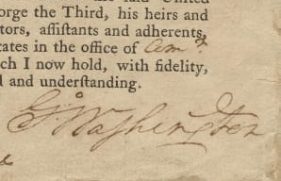
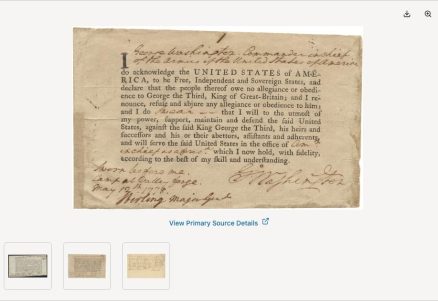
Have students look closely at either George Washington, Alexander Hamilton, or Aaron Burr’s Oath of Allegiance. Then ask students:
- Who or what are people swearing allegiance to? Who or what did the signer renounce?
- What was the oath-taker promising to do?
- What information was handwritten onto the oath? How does this information help us contextualize the document within the American Revolution?
Take it beyond the Continental Army’s Oaths of Allegiance and have students read the Oath of Allegiance to the King George III.
Ask Students:
- Compare and contrast the oath to King George III with the previous oaths.
- What event led to this oath being necessary? Why are people being asked to take this oath?
- Who or what are the oath-takers promising allegiance to?
- Which oath would you take and why?

To the extent possible under law, National Archives Foundation has waived all copyright and related or neighboring rights to “Compare and Contrast Oaths of Allegiance”
Description
In the 18th century, English military officials and office holders had to swear an oath to King George III, who was the defender of the Protestant Church of England, and people believed breaking these oaths would put their souls in danger. Oaths of allegiance and fidelity and oaths of office were taken mainly by Continental Army line and staff officers in accordance with a resolution of the Continental Congress of February 3, 1778. The oaths generally included the name of the subscriber, his rank or office, his organization, the date, the name and rank of the witness, and the place where the oath was taken.
Share this activity with your students
Documents in this Activity

Aaron Burr's Oath of Allegiance
Revolution and the New Nation (1754-1820s)
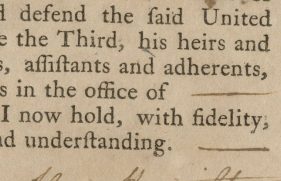
Alexander Hamilton's Oath of Allegiance
Revolution and the New Nation (1754-1820s)
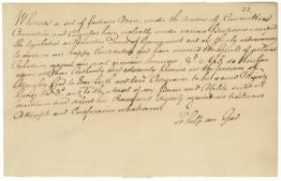
Oath of Allegiance to the King George III
Revolution and the New Nation (1754-1820s)