Checks and Balances in Action

Seeing the Big Picture
Share to Google Classroom

Recommended Activity
Published By:
National Archives Foundation
Historical Era:
Across Eras: Civics & Government
Thinking Skill:
Historical Analysis & Interpretation
Bloom’s Taxonomy:
Analyzing
Grade Level:
Middle School
Suggested Teaching Instructions
Learning Objectives:
Students will be able to identify and explain the interactions between the legislative, executive and judicial branches by critically analyzing primary sources related to “checks and balances.”
Instructions:
This activity may be used to conclude a unit of study into the creation of the US Constitution. The activity can be completed as a class, in small groups, in pairs, or individually. For grades 6-12. Approximate time needed is 20 minutes.
Start the lesson with a refresher of the definitions of the legislative, executive and judicial branches. Ask students to write a definition in their own words and to list powers related to each of these branches. Discuss the definitions and list the powers together as a class.
Ask students to define the system of checks and balances and explain how that relates to the definitions of the individual branches.
After discussing definitions, introduce the activity. Tell students they will be examining documents from throughout United States history to match examples of particular “checks and balances” with an appropriate explanation describing the branches involved and the type of interaction.
Open the activity and model document analysis with one of the documents. After reading the document outloud as a group, ask students to note which branches of government are involved in the document selected and how the system of checks and balances is operating. Ask students to match the document to the appropriate description.
After modelling the activity, tell students to analyze the remaining documents. As they analyze, students should note the particular branches associated with each document and type of interaction.
Following completion of the activity, lead a class discussion on the concluding question.
- Based on the documents included in this activity, which branch has the most powerful check on the other branches? Explain.

To the extent possible under law, National Archives Foundation has waived all copyright and related or neighboring rights to “Checks and Balances in Action”
Description
In this activity students will analyze documents that span the course of American history to see examples of “checks and balances” between the legislative, executive, and judicial branches in action. Students will then match the documents they have examined with an appropriate description of the branches of government involved in the action.
Share this activity with your students
Documents in this Activity

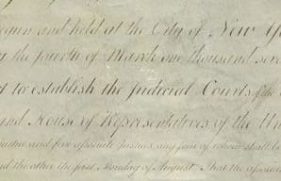
Constitution of the United States
Revolution and the New Nation (1754-1820s)
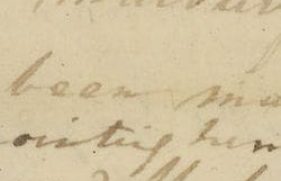
Draft of Motion Rule for Marbury v. Madison
Revolution and the New Nation (1754-1820s)