

Broadening the Perspective: Comparing D-Day Photographs

Compare and Contrast
Share to Google Classroom
Recommended Activity
Published By:
National Archives Foundation
Historical Era:
The Great Depression and World War II (1929-1945)
Thinking Skill:
Historical Analysis & Interpretation
Bloom’s Taxonomy:
Analyzing
Grade Level:
Middle School
Suggested Teaching Instructions
This activity can be used in units about World War II, primary sources, or African American history. For grades 7-12. Approximate time needed is 15-20 minutes.
Before beginning the activity, as a class, have students make a list of what they already know about D-Day. Then, ask them to describe any words, images, people, etc. that come to mind when they think about heroes and heroism on D-Day.
Next, model document analysis techniques by asking students to begin the activity and individually (or in small groups) respond to the following questions:
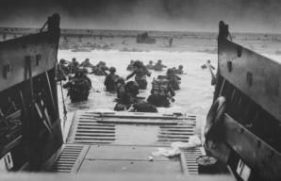
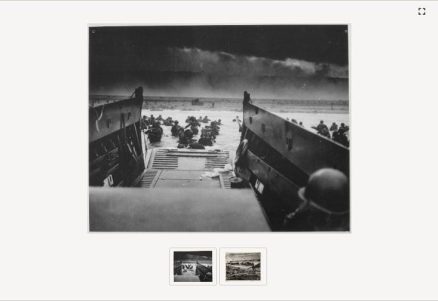
- What details stand out to you from the two photographs? People, objects, activities, etc.?
- What do you see that is the same in the two photographs?
- What do you see that is different in the two photographs?
Review student responses as a whole group. During the discussion, encourage students to think about similarities and differences in the photographs related to time, location, and the photographer’s perspective. To help students draw conclusions from their observations, prompt them to consider the “why” behind any similarities or differences present in the photographs.
Provide students with the following facts and background information, if necessary.
On June 6, 1944, more than 150,000 Allied troops launched the D-Day invasion, an amphibious assault on Nazi-occupied France. The over 600 members of the 320th Barrage Balloon Battalion who took part in the invasion were among the many thousands of men coming ashore that day on the Normandy beaches. But this African American unit had a specific mission. Their job, unlike many of their fellow soldiers, was not to advance off the Normandy beaches, but to provide aerial protection.
To do this, the 320th positioned low lying balloons (around 2,000 feet in altitude) anchored by reinforced steel cables on the Omaha and Utah beaches to protect troops and supplies from enemy strafing and bombings. Despite facing fierce enemy fire, the 320th managed to emplace twelve balloons on Omaha beach by the morning of June 7 and thirteen balloons on Utah beach by that evening.
After responding to the questions for both photographs, students should click on “When You’re Done.” Direct students to the following questions and lead a discussion based on the students’ answers. During the discussion, engage students in a dialogue about the potential limitations of using photographs as primary sources, such as a photographer’s perspective or the details omitted by the limited scope of a camera lens:
- What do we learn about the D-Day invasion by comparing the two photographs?
- What questions do the photographs raise? What questions do the photographs not answer?
- How do these photographs connect to or challenge your understanding of heroism as it relates to D-Day?

To the extent possible under law, National Archives Foundation has waived all copyright and related or neighboring rights to “Broadening the Perspective: Comparing D-Day Photographs”
Description
In this activity, students will analyze two photographs taken during or shortly after the D-Day invasion in June 1944, one related to the vital role played by the 320th Barrage Balloon Battalion (the only African American combat unit to land on the Normandy beaches during D-Day).
This activity also highlights how photographs serve as sources of historical information as well as their potential limitations as primary source records.
Share this activity with your students
Documents in this Activity
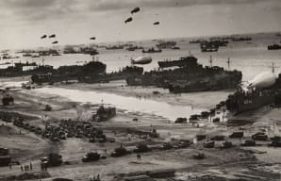
Photograph of the French Invasion Beach
The Great Depression and World War II (1929-1945)