


Birth of the Environmental Protection Agency

Mapping History
Share to Google Classroom

Recommended Activity
Published By:
National Archives Foundation
Historical Era:
Contemporary United States (1968 to the present)
Thinking Skill:
Historical Analysis & Interpretation
Bloom’s Taxonomy:
Analyzing
Grade Level:
High School
Suggested Teaching Instructions
Ask students to open and begin the activity. They will be provided with background information on the birth of the EPA and DOCUMERICA Project, and directions to label the map with topics of environmental concern that they think relate to the photos around the country.
After students label the map and click “When You’re Done,” they will be challenged to speculate what kinds of legislation Congress passed during those early years of the EPA. They will be directed to a list of laws on the EPA’s website to find specific acts of Congress that the EPA became tasked with enforcing.
Students may find the following:
- The Clean Air Act “regulates air emissions from stationary and mobile sources.”
- The Clean Water Act establishes the basic structure for regulating discharges of pollutants into the waters of the United States and regulating quality standards for surface waters.”
- The Federal Insecticide, Fungicide, and Rodenticide Act “provides for federal regulation of pesticide distribution, sale, and use.”
- The Noise Control Act of 1972 “establishes a national policy to promote an environment for all Americans free from noise that jeopardizes their health and welfare.”
- The Toxic Substances Control Act of 1976 “provides EPA with authority to require reporting, record-keeping and testing requirements, and restrictions relating to chemical substances and/or mixtures” and “addresses the production, importation, use, and disposal of specific chemicals including polychlorinated biphenyls (PCBs), asbestos, radon and lead-based paint.”
- The authority “to issue generally applicable environmental radiation standards” under the Atomic Energy Act of 1946 “was transferred to EPA” when it was formed.
- The Safe Drinking Water Act “was established to protect the quality of drinking water in the U.S. This law focuses on all waters actually or potentially designed for drinking use, whether from above ground or underground sources.”
After students explore the EPA’s website, conduct a class discussion based on the questions:
- Were [the regulations] passed in the early years of the EPA or later?
- Were there any issues not regulated that you feel should have been?

To the extent possible under law, National Archives Foundation has waived all copyright and related or neighboring rights to “Birth of the Environmental Protection Agency”
Description
By the late 1960s, issues of unchecked land development, urban decay, and air, noise, and water pollution came to Americans’ attention. In November 1971, the newly created Environmental Protection Agency (EPA) announced a large-scale photodocumentary project to record changes in the American environment. The DOCUMERICA Project, as it would be known, lasted from 1971 until 1977. The EPA hired freelance photographers to capture images relating to environmental problems, EPA activities, and everyday life in the 1970s. The project resulted in more than 20,000 photographs.
In this activity, students will analyze photographs taken as part of the United States Environmental Protection Agency’s (EPA) DOCUMERICA project. They will identify the environmental issues facing the United States in the early 1970s, and speculate what legislation and regulations Congress and the EPA would have passed and enforced based on the state of the environment as documented in the photos.
Read more about the DOCUMERICA Project, including its origins, scope, and the response it received in the National Archives Prologue Magazine.
Share this activity with your students
Documents in this Activity
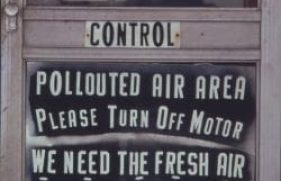
Pollution Sign Affixed to the Door of a Gasoline Service Station
Contemporary United States (1968 to the present)
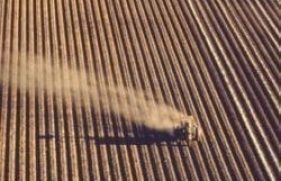

Clear Water At Outlet Of Sewage Treatment Plant Is Cleaner Than The Water Of The Stream It Will Be Dumped Into
Contemporary United States (1968 to the present)