

Be a Document Detective: Meet the Declaration of Independence

Analyzing Documents
Share to Google Classroom

Recommended Activity
Published By:
National Archives Foundation
Historical Era:
Revolution and the New Nation (1754-1820s)
Thinking Skill:
Historical Comprehension
Bloom’s Taxonomy:
Analyzing
Grade Level:
Lower Elementary
Suggested Teaching Instructions
This activity can be used during a unit on the American Revolution, the Declaration of Independence, or the values and principles of American democracy. For grades K-2. Approximate time needed is 20-30 minutes.
Students can complete the activity as a full class or in small groups. Tell students that they are going to act as “document detectives” to explore details about an old historical document called the Declaration of Independence. As such, students will use primary source document analysis to identify details from the Declaration of Independence. Ask students the following:
- What do detectives do?
- What type of skills does someone need to be a detective?
Students may tell you that detectives need to be smart, they need to look closely at details, pay attention to clues, piece together information they find to determine what is happening. Tell students that as document detectives, they will be using these same skills to learn more about the Declaration of Independence.
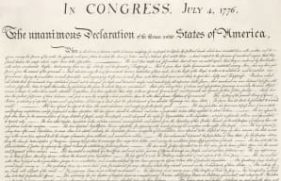
Use the Analyze a Written Document resource sheet to guide the class discussion of the Print of the Declaration of Independence. Direct students to look at the top section of the document and ask some general open-ended questions.
- What do you notice about it?
- How would you describe it?
- What parts stand out?
After discussing their general observations of this section, direct students’ attention to the date on the document if this has not been discussed yet. Ask students the following:
- Can you find any numbers?
- Can you find the year on the document? What is the date?
- Have you ever celebrated on the 4th of July? If so, what do you do to celebrate?
Inform students that July 4th is the date that the Second Continental Congress adopted this document–the Declaration of Independence. If needed, share a basic definition of the terms.
- Declaration means an official or public statement about something.
- Independence means freedom from being ruled by another group.
Share the following historical context, if necessary:
The name Declaration of Independence describes what the document was doing. The United States used to be a colony ruled by Great Britain. During that time, King George III was the ruler of Great Britain and, therefore, the British colonies, including the thirteen colonies that would become the United States.
That at the time of the Declaration of Independence, American colonists were upset that they did not have a say in how they were governed by Great Britain. The American colonists did not feel that King George III represented their interests; they believed that it would be better for their communities to break free from British rule and become an independent nation.
The Declaration of Independence was the document that announced this statement of independence for the colonies. That is why the Fourth of July holiday is officially called Independence Day.
Direct students to look at the middle section of the document and ask some general open-ended questions.
- What do you notice about it?
- How would you describe it?
- What parts stand out?
After discussing their general observations of this section, inform students that this section explains why the American colonies want to be a separate country and lists all the bad things that King George III did in recent years. Focus attention on the phrase that begins the second paragraph- “We hold these truths to be self-evident, that all men are created equal.” Share that this is one of the most well-known phrases from the document. Its meaning has continued to inspire Americans for the past 250 years. Ask students to share what they think it means.
- What does the idea that “all men are created equal” mean to them?
- What does “all men are created equal” mean for creating a government?
Direct students to look at the bottom section of the document and ask some general open-ended questions.
- What do you notice about it?
- How would you describe it?
- What parts stand out?
After discussing their general observations, direct students’ attention to the signatures on the document if this has not been discussed yet.
- What do you notice about the handwriting of this section?
- Why do you think people put their signature on something?
- Why do you think people signed this document?
- Was signing the Declaration of Independence a brave thing to do?Why or why not?
Share the following historical context, if necessary:
Although it bears the date “July 4, 1776,” the Declaration of Independence was signed on August 2, by members of the Continental Congress who were present that day and later by other members of Congress.
John Hancock, the President of the Congress, signed the engrossed copy with a bold signature. The other delegates, following custom, signed beginning at the right with the signatures arranged by states from northernmost New Hampshire to southernmost Georgia. This included 2 future Presidents, John Adams and Thomas Jefferson, who also worked on the first draft of the Declaration.
56 delegates eventually signed the document. Signing the document reflected their agreement with its meaning. Copies were printed and shared throughout the colonies.
After completing the activity, students should answer the following:
- What is the Declaration of Independence and why was it important?
For additional materials related to Be a Document Detective: Meet the Declaration of Independence (including Guiding Questions, National Standards, Historical Background and Supplemental Educational Resources).

To the extent possible under law, National Archives Foundation has waived all copyright and related or neighboring rights to “Be a Document Detective: Meet the Declaration of Independence”
Description
In this activity, students will examine a Print of the Declaration of Independence and share their observations about the primary source document.