


Baseball on the World War I Homefront

Making Connections
Share to Google Classroom
Recommended Activity
Published By:
National Archives Foundation
Historical Era:
The Emergence of Modern America (1890-1930)
Thinking Skill:
Historical Analysis & Interpretation
Bloom’s Taxonomy:
Analyzing
Grade Level:
Middle School, High School
Suggested Teaching Instructions
This activity fits into a unit on World War One. For grades 7-12. Approximate time needed is 20–30 minutes.
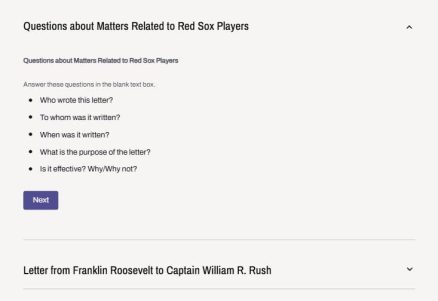
Ask students to begin the activity, which will direct them to focus on page 10 of the correspondence first (the letter provided in the next box in the activity). Students will practice document analysis techniques by answering the following questions:
- Who wrote this letter?
- To whom was it written?
- When was it written?
- What is the purpose of the letter? or Why do you think it was written?
- Is it effective? Why/Why not?
Review student answers in a large group format to ensure understanding. Then ask students to go back and examine the letter initially sent to Roosevelt and enclosed with his letter, on pages 11–13 (page 11 is provided in the activity; students should click on “View Primary Source Details” to read the subsequent pages). Students should consider these questions:
- Why did Boston Red Sox Owner and President Harry H. Frazee write this letter to Roosevelt?
- What does he request?
- What reasons does he provide for his request?
Engage students in a discussion about recreational activities during wartime. If you were Captain William Rush, Commandant of the First Naval District in Boston, what would you do?
When students click “When You’re Done,” they will be tasked with reflecting on the correspondence they just read, and writing a paragraph addressing the following questions:
- Should baseball and other professional sport continue when our country is at war?
- Should professional athletes be excused or exempted from military service?
Share the following information with students:
Many baseball owners contributed to the war effort—providing the armed services with baseball equipment, raising funds, and hosting exhibition games. But the same owners felt the strain and tension after losing numerous players to the war. Frazee’s letter clearly demonstrated this tension between business needs and patriotic duty. And when local newspapers reported the possibility of leave for Red Sox players, the Navy stood firm and the players remained sailors.
Baseball was declared a non-essential occupation during the middle of the 1918 baseball season. With the loss of star players, the baseball owners cut the season short, ending it at Labor Day. Over 200 professional baseball players entered military service in World War I. The rest found employment in factories producing for the war after the 1918 season concluded.

To the extent possible under law, National Archives Foundation has waived all copyright and related or neighboring rights to “Baseball on the World War I Homefront”
Description
In this activity, students will analyze a letter written by Assistant Secretary of the Navy Franklin D. Roosevelt to begin to understand the WWI homefront and the changes that occurred in American society and the role of recreational activities, specifically baseball, during the war. Students will analyze correspondence between Roosevelt and Boston Red Sox Owner and President Harry H. Frazee. Roosevelt suggested the temporary detachment of two Boston Red Sox baseball players from service in the U.S. Navy.