

Arguments in Favor and Against Participating in 1936 Olympics

Compare and Contrast
Share to Google Classroom

Recommended Activity
Published By:
National Archives Foundation
Historical Era:
The Great Depression and World War II (1929-1945)
Thinking Skill:
Historical Issues-Analysis & Decision-Making
Bloom’s Taxonomy:
Analyzing
Grade Level:
Middle School, High School
Suggested Teaching Instructions
This activity can be used in units about international diplomacy, World War II, or the Holocaust. For grades 7-12. Approximate time needed is 20-30 minutes.
Before beginning the activity, organize students into small groups. Ask students what the word boycott means. Ask students to take 30 seconds to read the word silently and write down any thoughts or words that come to mind. Student groups should then take a few minutes to discuss their words and thoughts and write a shared definition.
Share a dictionary definition of the word boycott:
- Definition: withdraw from commercial or social relations with (a country, organization, or person) as a punishment or protest; to refuse to buy a product or take part in an activity as a way of expressing strong disapproval.
- Synonyms: ban, reject, exclude, block, repudiate, avoid, etc.
Based on the definition and discussion, ask students:
- What are some historical or modern-day examples of boycotts?
- What were the reasons for these boycotts? What were the counterarguments against these boycotts?
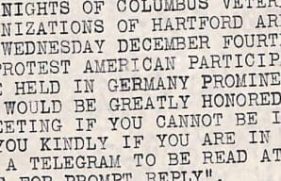
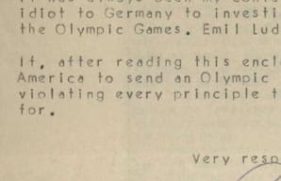
Prompt students to carefully examine the two documents with the discussion questions provided. Remind them to click on the magnifying glass for further detail.
Explain to students that they will review a variety of documents related to the debate about boycotting the 1936 Summer Olympics that were held in Berlin under the Nazi regime of Adolph Hitler. Explain to the class that there were different points of view about participation in this event.
Model document analysis techniques by asking students to begin the activity and individually respond to the following questions:
- What are the dates of these letters?
- What is the author’s motivation for writing?
- Who are the letters written to? Did the author receive a response?
- List the reasons given for and against a U.S. boycott of the 1936 Olympic games. What evidence, if any, does each author use to support his claims?
Provide students with the following facts and background information if necessary.
Responding to reports alleging human rights violations against Jewish people in Germany, a variety of stakeholders (including American athletes, Olympic organizers, government officials, and the general public) debated whether the United States should boycott the event.
Some argued that going forward with the games would show support for Adolf Hitler and the Nazi government, whose policies of discrimination they argued were against the Olympic ideal.
Others argued that politics had no place in sport, and boycotting the games would deprive athletes of the opportunity to represent their country and compete for a medal in their sport.
After responding to the questions for both sets of letters, students should click on “When You’re Done.” Read and paraphrase (if necessary) the quote from Secretary of State Cordell Hull about the government having no role in deciding American participation in the Olympic games. Direct students to the following question and lead a discussion based on the students’ answers:
- Do you agree with Secretary of State Cordell Hull’s belief that politics has no role in the Olympic games and other international sporting events? Why or why not?
As an extension activity, your class can analyze photographs from the 1936 Berlin Olympics and discuss the ways the Nazi regime exploited the event for propaganda purposes:
- Hitler Watching the Olympic Games in Berlin, Germany
- 1936 Olympic Stadium in Berlin, Germany
- Jesse Owens at the 1936 Olympics in Berlin, Germany (mid-race)
- Jesse Owens at the 1936 Olympics in Berlin, Germany (post-race)

To the extent possible under law, National Archives Foundation has waived all copyright and related or neighboring rights to “Arguments in Favor and Against Participating in 1936 Olympics”
Description
In this activity, students will analyze arguments for and against U.S. participation in the Olympic games. Students will begin to understand what Americans knew about the Nazi regime’s anti-Jewish legislation and the Roosevelt administration’s stance about the role of politics in sports.
Share this activity with your students
Documents in this Activity
Letter from Aaron Gamsey to President Roosevelt about 1936 Olympics
The Great Depression and World War II (1929-1945)