

Analyzing the Gulf of Tonkin Resolution (Original Draft Resolution)

Analyzing Documents
Share to Google Classroom
Recommended Activity
Published By:
National Archives Foundation
Historical Era:
Postwar United States (1945 to early 1970s)
Thinking Skill:
Historical Analysis & Interpretation
Bloom’s Taxonomy:
Analyzing
Grade Level:
High School
Suggested Teaching Instructions
This activity can be used during a unit on the Vietnam War. It can serve as an introduction to the Tonkin Gulf Resolution. For grades 9-12. Approximate time needed is 30 minutes.
As a class, watch President Johnson’s Vietnam address, delivered on August 4, 1964.
As students watch the video, ask them to write down answers to the following questions:
- What is President Johnson asking Congress to do? Why?
After the video, discuss students’ responses as a class.
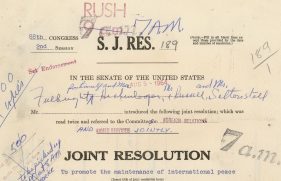
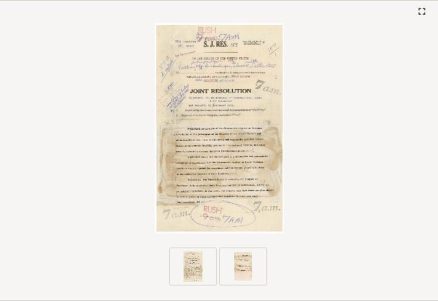
Next, students will look at the draft version of the Tonkin Gulf Resolution. This can be done individually, in pairs, or as a full class. Direct students to take a minute to examine the document, then to respond to the questions.
After students have answered all of the analysis questions, ask them to share their answers to the following questions:
- What does Congress authorize the president to do?
- What rationale does Congress use to justify this authorization?
Make sure that students point out specific evidence from the document to support their answers. For the second question, students should draw support from the “whereas” clauses on the first page of the document.
Additional Discussion Questions:
- Ask students what they think “all necessary measures” and “all necessary steps, including the use of armed force” might mean.
- Does Congress place any limitations on the President’s authority?
- According to the resolution, when does this authorization expire?
Share Additional Background Information, if necessary:
You may wish to share additional information with students about the events leading up to the Tonkin Gulf Resolution that was not widely known at the time this resolution was approved by Congress. Ask students to reflect on how this new information changes our understanding of the Tonkin Gulf Resolution.
On August 4, 1964 the USS Maddox captain reported that he was “under continuous torpedo attack.” But he later cabled “freak weather effects on radar and overeager sonarmen may have accounted for many reports.” Defense Secretary Robert McNamara did not report the captain’s doubts to President Johnson, however. (A 2002 National Security Agency report made available in 2007 confirmed the August 2 attack, but concluded the August 4 attack never happened.)
A later Senate investigation revealed that the Maddox had been conducting electronic eavesdropping on North Vietnam to assist South Vietnamese Army (ARVN) commando raids on North Vietnamese targets. President Johnson had originally portrayed confrontations between U.S. and North Vietnamese ships off the coast of North Vietnam as unprovoked aggression when he addressed Congress.

To the extent possible under law, National Archives Foundation has waived all copyright and related or neighboring rights to “Analyzing the Gulf of Tonkin Resolution (Original Draft Resolution)”
Description
In this activity, students will carefully analyze the draft version of the Tonkin Gulf Resolution. They will determine the authority Congress granted the President of the United States and the rationale Congress used to justify this resolution.