

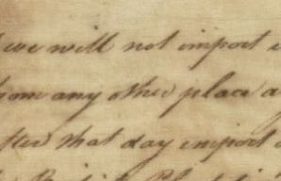
Analyzing the Articles of Association

Analyzing Documents
Share to Google Classroom

Recommended Activity
Published By:
National Archives Foundation
Historical Era:
Revolution and the New Nation (1754-1820s)
Thinking Skill:
Historical Analysis & Interpretation
Bloom’s Taxonomy:
Analyzing
Grade Level:
High School
Suggested Teaching Instructions
This activity can be used during a unit on the American Revolution or while exploring key American ideals and values from our Founding documents.. For grades 7-12. Approximate time needed is 30-45 minutes.
Direct students to examine the Articles of Association. This can be done individually, in pairs, or as a full class. They should proceed to answer the questions that follow, which will guide them through the process of written document analysis:
- Meet the document.
- Observe its parts.
- Try to make sense of it.
- Use it as historical evidence.
If necessary, check in with your students at each step in the process and model analysis if required. Remind students to read both pages of the main argument and skim the page that lists the signatories.
After completing and discussing the analysis questions, direct students to “When You’re Done.” They will be directed to go back to the document and compare and contrast the language, style, and tone of the Articles of Association with selections from the Declaration of Independence that was created less than two years later.
Direct students to pay particular attention to how the two documents describe the colonists, King George III, the British actions occurring within the colonies, and the proposed responses from the colonists.
- How do the two documents relate to each other?
- What are some major similarities between these two documents?
- What are some major differences between these two documents?
Provide additional contextual information if required.
Written by the First Continental Congress, this document addressed economic grievances imposed on the colonies. The articles implemented a trade boycott with Great Britain – asserting non-importation and non-exportation sanctions on Great Britain, Ireland, and the East Indies – in reaction to the British Crown’s infamous 1774 Intolerable Acts.
In 1773, the Sons of Liberty, a secret society of American rebels, had dumped a shipload of tea into the Boston Harbor, protesting “taxation without representation.” The following year, two years before the start of the American Revolution, the British Crown responded to the Boston Tea Party by passing what the American Patriots called the Intolerable Acts.
The Intolerable Acts were a series of four legislative acts imposed by Great Britain on the colonies in order to punish them and to quell the rising rebellion.
The acts were comprised of:
- The Boston Port Act, which closed the port of Boston
- The Massachusetts Government Act, which required that all Massachusetts government positions be appointed by either the Crown itself, the Governor, or Parliament
- The Administration of Justice Act, which asserted that trials against officials of the Crown were to take place in Great Britain and not in Massachusetts if the Crown believed Massachusetts incapable of executing a fair trial
- The Quartering Act, which allowed Royal soldiers to be housed in unoccupied buildings
The Articles of Association asserted that, in order to free themselves economically from Great Britain, the colonies will “encourage frugality, economy, and industry, and promote agriculture, arts and the manufactures of this country.” The authors viewed Great Britain’s authority as tyrannical and understood that they needed to control and use their own resources to survive without Great Britain.
To apply maximum pressure on the British economy (and Parliament), the articles also called for the establishment of local committees to enforce the Continental Association throughout the colonies. The policy was highly effective. In the first six months of 1775, the value of British imports to America fell from £3 million to £220,000. America’s economic independence would lead to its political independence. The Articles of Association later inspired the 1776 Declaration of Independence.

To the extent possible under law, National Archives Foundation has waived all copyright and related or neighboring rights to “Analyzing the Articles of Association”
Description
In this activity, students will carefully analyze the Articles of Association written by the First Continental Congress in response to the Intolerable Acts being passed by the British Parliament following the Boston Tea Party.