

Analyzing Rosa Parks’s Arrest Record

Analyzing Documents
Share to Google Classroom
Recommended Activity
Published By:
National Archives Foundation
Historical Era:
Postwar United States (1945 to early 1970s)
Thinking Skill:
Historical Analysis & Interpretation
Bloom’s Taxonomy:
Analyzing
Grade Level:
Upper Elementary, Middle School
Suggested Teaching Instructions
This activity can be used during a unit on the Civil Rights movement, in teaching about protests and civil disobedience, or when focusing on Rosa Parks’s story. For grades 3-5. Approximate time needed is 35 minutes.
To spark student interest at the beginning of the activity, display Rosa Parks’s Fingerprint Card and ask students to examine the document for 1 minute. Then ask students the following questions:
- What kind of document is this?
- For what reason was this document created?
- What are some unanswered questions you have about this document?
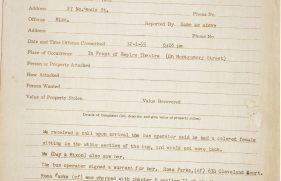
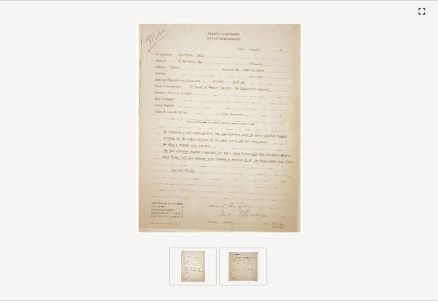
After discussing student responses to these questions as a whole class, tell students that they are going to spend some time finding the answers to their questions by becoming “document detectives.” Students can complete this part of the activity as a whole class, in small groups, or in pairs. Students will use primary source document analysis to identify key details from the Record of Rosa Parks’s arrest.
- Meet the document
- Observe its parts
- Try to make sense of it
Ask groups to share details they discovered about the document with the whole class. If needed, walk students through each stage of the document analysis process, sharing out details as you go.
Following the whole class discussion about the main idea and purpose of Rosa Parks’s arrest record, share the following background information about the document:
On December 1, 1955, during a typical evening rush hour in Montgomery, Alabama, a 42-year-old woman took a seat on the bus on her way home from the Montgomery Fair department store where she worked as a seamstress. Before she reached her destination, she quietly set off a social revolution when the bus driver instructed her to move back, and she refused.
Rosa Parks, an African American, was arrested that day for violating a city law requiring racial segregation of public buses. In police custody, Mrs. Parks was booked, fingerprinted, and briefly incarcerated. The police report shows that she was charged with “refusing to obey orders of bus driver.” Ms. Parks took part in a deliberate planned act of civil disobedience by refusing to relinquish her seat on a public bus.
Define the term “civil disobedience” (the refusal to comply with laws as a peaceful form of political protest). Based on students’ skill level, consider asking students what they think the term “civil disobedience” means using context clues from the background story about Rosa Parks’s arrest before sharing the definition.
To conclude the discussion about Rosa Parks arrest record and to highlight the impact of her peaceful protest, display the image of the Bus in Montgomery, Alabama and share the following with students:
This photograph of an almost empty bus was taken during the Montgomery Bus Boycott. Parks was not the first Black woman to refuse to give up her seat, but she was a woman of unchallenged character. As a result, she had the political backing and resources to garner public attention. Her arrest sparked the 1955-56 Montgomery bus boycott (70% of bus riders were African American) which lasted over a year.
The well-organized, non-violent protest, organized by the Montgomery Improvement Association, hurt municipal revenues and helped focus national attention on Martin Luther King, Jr. For this quiet act of defiance that resonated throughout the world, Rosa Parks is known and revered as the “Mother of the Civil Rights Movement.”
Encourage students to reflect on the ideals promised to us by the Declaration of Independence and highlight for students that Rosa Parks took a stand against injustice when she felt that her fundamental rights were being violated. Explain to students that throughout our history individuals, such as Rosa Parks, have used forms of peaceful protest to fight for change when they thought something was wrong.
The Declaration of Independence emphasizes the importance of the individual and individual rights – all men are created equal and all people have the right to life, liberty, and the pursuit of happiness. The rights and freedoms embodied in the Declaration of Independence did not initially apply to all Americans. Groups in American society have struggled to achieve the liberties and equality promised in the principles of American democracy.
Instruct students to click “when you’re done” to respond to the following questions in small groups or pairs. Encourage students to share their responses with the class to wrap up class discussion:
- What does it mean to take a stand against something that you think is wrong?
- What lessons can we learn from Rosa Parks’s story about the power of individual action to promote change in a peaceful way?
For additional materials related to Analyzing Rosa Parks’s Arrest Record (including Guiding Questions, National Standards, Historical Background and Supplemental Educational Resources).

To the extent possible under law, National Archives Foundation has waived all copyright and related or neighboring rights to “Analyzing Rosa Parks’s Arrest Record”
Description
In this activity, upper elementary school students will analyze Rosa Parks’s Arrest Record. After reviewing key details from the arrest record, students will consider what it means to take a stand against injustice and what lessons can we learn from Rosa Parks’s story about the power of individual action to promote change in a peaceful way.