

Analyzing Photographs from Carlisle Indian School

Compare and Contrast
Share to Google Classroom

Recommended Activity
Published By:
National Archives Foundation
Historical Era:
The Emergence of Modern America (1890-1930)
Thinking Skill:
Historical Analysis & Interpretation
Bloom’s Taxonomy:
Analyzing
Grade Level:
Upper Elementary
Suggested Teaching Instructions
This activity can be used during a unit on Indigenous histories or during a unit on the fundamental values and principles from the Declaration of Independence.
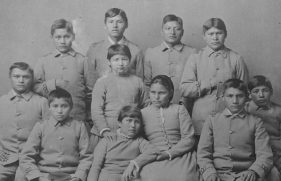
Present the activity to the entire class. Prompt students to carefully examine the two photographs.
Direct students to the first photograph, “Chiricahua Apache Students After Training at the Carlisle Indian School.” Model careful document (photograph) analysis by guiding students through the following questions:
- Meet the photo
- What do you see?
Is the photo black or white?
- What do you see?
- Observe its parts
- What do you see in the photo (people, objects, both)?
- What are the people doing in the photo?
- Write two words that describe the photo.
- Try to make sense of it.
- Where do you think this photo was taken?
- Why do you think the photo was taken?
Direct students to the second photograph, “Chiricahua Apache Children Upon Arrival at the Carlisle Indian School.” Ask students to answer the same questions for this photo.
Next, instruct students to compare and contrast the photographs in small groups or pairs:
- Ask them what major differences are apparent
- Ask students how these two images may directly relate to each other.
- If students hypothesize that they depict the same children, ask them to provide evidence that supports that view.
- Ask students to guess how much time had passed between the photographs (four months).
Share the following contextual information with students about the photographs:
These Chiracahua Apache students were photographed at the Carlisle Indian School, near Harrisburg, Pennsylvania, upon their arrival in 1886 and then again four months later. At Carlisle and other schools, Native American students were required to abandon traditional ways and learn a trade. The Indian boarding school system, of which the Carlisle School was a part, implemented strict military discipline and policies such as changing the students’ Native names to English ones, and punishing them for speaking their Native language or practicing their religious beliefs.
The Bureau of Indian Affairs, known as the Office of Indian Affairs until 1947, ran schools like Carlisle both on and off Indian reservations. The schools were part of the Federal Government’s attempt to “Americanize” Native children through assimilation.
Explain to students what the term “assimilation” means.
- Ask students how this information changes their perspective of the photographs.
- What do you think it would feel like to be taken away from your family and sent to live somewhere new?
- What are some things that are important to your identity? What are ways you express your identity? How might it feel if someone tried to make you stop doing those things?
After comparing and contrasting the photographs, ask students to reflect on the values and beliefs promised by the Declaration of Independence.
Explain to students that the Declaration of Independence emphasizes the importance of the individual and individual rights – all men are created equal and all people have the right to life, liberty, and the pursuit of happiness. The promise of individual rights from the Declaration of Independence sets the foundation for the protection of personal freedoms that we find in our other founding documents, such as freedom of speech and freedom of religion. The rights and freedoms embodied in the Declaration of Independence did not initially apply to all Americans.
Groups in American society have struggled to achieve the liberties and equality promised in the principles of American democracy. Indian Boarding schools, such as the Carlisle Indian School, hoped to “Americanize” Native children by imposing certain customs, beliefs, and habits on their way of life. While in these schools, Native children were often required to change their name, stop speaking their Native language, and give up their religious beliefs.
The story of Native Children in Indian Boarding schools highlights some of the conflicts caused by diversity in American history, and how different groups have had to fight for their right to equality.
- Why is diversity important in an American democracy?
- How can we work together to handle conflicts about diversity?
For additional materials related to Analyzing Photographs from Carlisle Indian School (including Guiding Questions, National Standards, Historical Background and Supplemental Educational Resources).

To the extent possible under law, National Archives Foundation has waived all copyright and related or neighboring rights to “Analyzing Photographs from Carlisle Indian School”
Description
In this activity, upper elementary school students will compare and contrast images of Native American children taken at the Carlisle Indian School. Students will examine these images to understand how groups in American society have struggled to achieve the liberties and equality promised in the principles of American democracy.
Share this activity with your students
Documents in this Activity
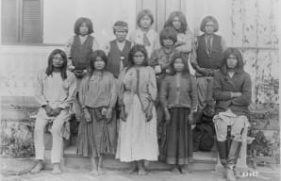
Chiricahua Apache Children Upon Arrival at the Carlisle Indian School
The Development of the Industrial United States (1870-1900)