

Analyzing Jackie Robinson’s White House Letter

Spotlight
Share to Google Classroom
Recommended Activity
Published By:
National Archives Foundation
Historical Era:
Contemporary United States (1968 to the present)
Thinking Skill:
Historical Analysis & Interpretation
Bloom’s Taxonomy:
Analyzing
Grade Level:
Middle School, High School
Suggested Teaching Instructions
This activity is appropriate for students in grades 7-12. Approximated time needed is 20 minutes. The activity can be completed individually, in pairs, or as a whole-class discussion.
Students may be familiar with Jackie Robinson as the legendary athlete who broke the color barrier in American baseball; yet they may not be aware of his civil rights activism. Students may be interested to learn that Robinson advocated for his civil rights when he served in the army during World War II, before his professional baseball career. As an Army Lieutenant, Robinson refused to move to the back of a southern bus when directed to do so by the driver of the bus. After retiring from professional baseball in 1957, Robinson used the influence he had from his sports career to champion the cause of civil rights until his death in 1972. He wrote and sent telegrams to multiple U.S. presidents and participated in the 1963 March on Washington.
Begin the activity in a full-class setting. Review with students some of the key accomplishments and dates of the civil rights movement. Next, ask students what they know about Jackie Robinson. Jack Roosevelt Robinson (1919-72), the first black man to “officially” play in the big leagues in the 20th century, possessed enormous physical talent and a fierce determination to succeed. In the course of a distinguished 10-year career beginning in 1947, Robinson led the Brooklyn Dodgers to six National League titles and one victorious World Series.
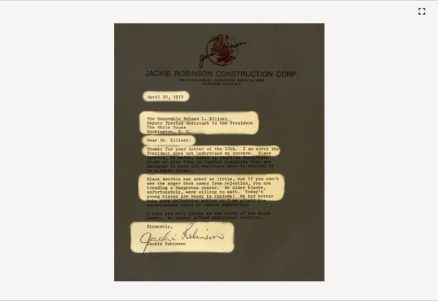
After the class discussion, open the activity and show students the letter with text spotlighted. Ask students where the date 1972 falls in relation to the civil rights events that they brainstormed earlier. Then examine the letter for word choices. Ask students to identify the five most powerful words in the letter. How do the word choices contribute to the tone of the letter?
Divide the class into groups. Direct each group to discuss the following:
- What are the author’s emotions?
- What is the author’s motivation for writing?
- Why do you think Jackie Robinson chose the White House as the audience for this letter?
Ask the groups to share their responses during a class discussion. Depending on available time and background knowledge, students can explore Robinson’s meaning and the historical context in the line “We older blacks, unfortunately, were willing to wait. Today’s young blacks are ready to explode!”
Direct students to the “When You’re Done” section and ask them to answer the following:
- What does Jackie Robinson’s letter to the White House tell you about the success of the civil rights movement?
Invite students to share their responses during a follow-up class discussion, or ask them to write their responses using text from the letter to support their answers.

To the extent possible under law, National Archives Foundation has waived all copyright and related or neighboring rights to “Analyzing Jackie Robinson’s White House Letter”
Description
In this activity, students will focus on a letter that Jackie Robinson wrote to the Nixon White House in 1972. Students will discover that racial equality had not been fully achieved, despite the end of the civil rights movement in 1968. Students will consider tone, audience, and historical context to create an argument and arrive at a conclusion.