

Analyzing FDR’s First Inaugural Address

Discussion Topic
Share to Google Classroom
Recommended Activity
Published By:
National Archives Foundation
Historical Era:
The Great Depression and World War II (1929-1945)
Thinking Skill:
Historical Analysis & Interpretation
Bloom’s Taxonomy:
Analyzing
Grade Level:
Middle School, High School
Suggested Teaching Instructions
This activity can be used during a unit on the Great Depression. It can serve as an introduction to the presidency of Franklin D. Roosevelt and the New Deal. For grades 6-12. Approximate time needed is 20 minutes.
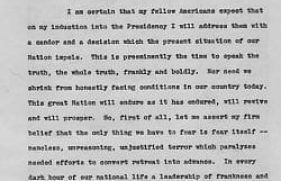
Present the activity to the entire class. Inform students that they will be reading and summarizing a famous inaugural address. Explain to students that inauguration is the ceremonial process in which a person elected begins the term of the Presidency. After taking the Presidential oath of office, Presidents give a speech known as their inaugural address. One of the most famous inaugural addresses is FDR’s speech given in March 1933 at the height of the Great Depression.
To begin, model document analysis. Read the opening aloud as a class and direct students to pay attention to the overall purpose and tone of the document. As you read the opening paragraph, direct students to note the following:
- What specific problems does FDR explain were caused by the Great Depression?
- What specific solutions does FDR propose to solve those problems?
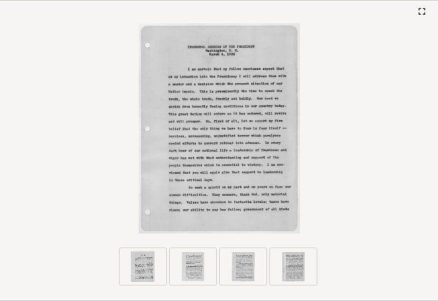
After discussing the initial problems and solutions, direct students to continue reading the speech (students should click on “View Primary Source Details” to see additional pages), noting the problems and solutions along the way. Check progress and ask students to share their findings.
After completing the activity, ask students to compare FDR’s inaugural to other Presidential inaugural addresses or speeches during times of crises (for example, Lincoln’s second inaugural).
This activity was adapted from “FDR Election” in the New York City Department of Education’s Passport to Social Studies, Grade 8, Unit 4, Lesson 14 (pg. 184-190).

To the extent possible under law, National Archives Foundation has waived all copyright and related or neighboring rights to “Analyzing FDR’s First Inaugural Address”
Description
In this activity, students will analyze President Franklin D. Roosevelt’s famous first inaugural address to explain the problems and proposed solutions to the Great Depression.