

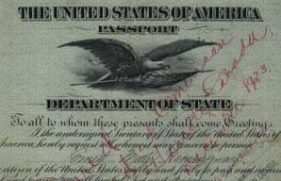
Analyzing Ernest Hemingway’s Passport

Analyzing Documents
Share to Google Classroom

Recommended Activity
Published By:
National Archives Foundation
Historical Era:
The Emergence of Modern America (1890-1930)
Thinking Skill:
Historical Analysis & Interpretation
Bloom’s Taxonomy:
Analyzing
Grade Level:
Upper Elementary, Middle School
Suggested Teaching Instructions
This activity is appropriate in a study of the life of Ernest Hemingway and in primary source document analysis. For grades 5-8. Approximate time needed is 20 minutes.
Before beginning document analysis, ask students to explain what a passport is and why people get them. If no definition is provided, tell students that passports are used by American citizens to travel abroad. Though they were not required for travel until 1941, the Department of State has issued passports to American citizens since 1789.
Students can complete the activity individually, in pairs, or as a full class. Direct students to begin by taking a minute to examine the document, then responding to the questions. They can click on “View Primary Source Details” to access a transcript of the document, since it is difficult to read.
Students should proceed to answer the questions that follow, which will guide them through the process of written document analysis. If necessary, check in with your students at each step in the process and model analysis if required.
- Meet the document.
- Observe its parts.
- Try to make sense of it.
- Use it as historical evidence.
After students have analyzed the document, share the following contextual information:
After serving in the American Red Cross as an ambulance driver in Italy during World War I, Ernest Hemingway returned to Europe in 1921. His 1921 passport contains a photograph of him as a young, though serious, man.
Initially working as a correspondent for the Toronto Star, while living in Paris he grew into a novelist with the encouragement of such notables as Gertrude Stein, Ezra Pound, and F. Scott Fitzgerald.
His time in Europe as a disillusioned expatriate (as a member of the so called “Lost Generation”) inspired his 1926 novel The Sun Also Rises.
Direct students to the “When You’re Done” section to answer the following:
- How do the questions and details provided on Ernest Hemingway’s 1921 Passport compare to a Passport Application from today’s State Department?
- What details have changed? What details have remained the same?

To the extent possible under law, National Archives Foundation has waived all copyright and related or neighboring rights to “Analyzing Ernest Hemingway’s Passport”
Description
In this activity, students will carefully analyze Ernest Hemingway’s Passport from 1921. They will determine the types of information one can gather about individuals from early 20th century passport records.