


Analyzing a Photograph of Bessie Coleman

Analyzing Documents
Share to Google Classroom
Recommended Activity
Published By:
National Archives Foundation
Historical Era:
The Emergence of Modern America (1890-1930)
Thinking Skill:
Historical Analysis & Interpretation
Bloom’s Taxonomy:
Analyzing
Grade Level:
Lower Elementary
Suggested Teaching Instructions
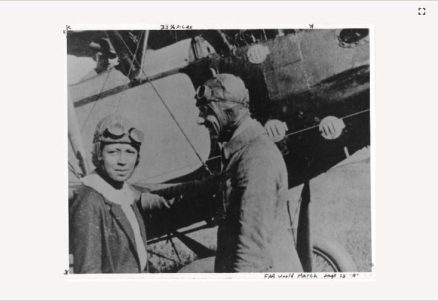
Using the activity questions, lead students through photograph analysis and a discussion about the details they observe in this 1920s photo of Bessie Coleman taken around the time she earned her pilot license. For grades K-2. Approximate time needed is 20 minutes.
As with any primary source analysis, ask students to go through the following progression, as outlined in the activity:
- Meet the document.
- Observe its parts.
- Try to make sense of it.
- Use it as historical evidence.
You may wish to draw students’ attention to the details on Bessie Coleman’s clothes, expression, the plane, and other details.
If desired, share the following historical details about Bessie Coleman:
Bessie Coleman was the first African American and Native American woman pilot. She was known for her daring stunt tricks in the air and performed for audiences in both the United States and Europe. Coleman was born on January 26, 1892, in Atlanta, Texas, to a large family. She grew up in Texas and briefly attended college at the Colored Agricultural and Normal University in Oklahoma before dropping out due to a lack of tuition money.
In 1915, Coleman moved to Chicago to join her brothers. They served in World War I and told her about how women in France were more commonly allowed to fly airplanes, unlike in the United States. This inspired Coleman to apply to flight schools across the United States, but she was rejected from all of them due to her being African American and a woman. Undeterred, Coleman began taking French classes and applied to flight schools in France, which were more welcoming.
Coleman was eventually accepted at the Caudron Brothers’ School of Aviation in France and formally received her international pilot’s license on June 21, 1915. To earn money for her own plane, Coleman went on speaking tours and showed films of her flights to audiences all over, with the caveat that the places she went to could not discriminate against African Americans. In 1922, she became the first African American woman to complete a public flight and audiences were thrilled with her loop-the-loop and Figure 8 tricks in her plane. She also became known for giving flight lessons and inspiring both Africans Americans and women to fly planes.

To the extent possible under law, National Archives Foundation has waived all copyright and related or neighboring rights to “Analyzing a Photograph of Bessie Coleman”
Description
In this activity, students will answer questions to help them analyze a photograph of Bessie Coleman, the first African American and Native American woman to receive a pilot’s license. They will also compare this photograph with their expectations of what a pilot looks like.