


Analyzing a Gag Rule Petition

Analyzing Documents
Share to Google Classroom
Recommended Activity
Published By:
National Archives Foundation
Historical Era:
Expansion and Reform (1801-1861)
Thinking Skill:
Historical Analysis & Interpretation
Bloom’s Taxonomy:
Analyzing
Grade Level:
Middle School
Suggested Teaching Instructions
This activity can be used in units about the abolitionist movement, slavery, the Civil War, or a civic lesson about the Declaration of Independence or the Bill of Rights. For grades 6-8. Approximate time needed is 30 minutes.
Before beginning the activity, as a class, ask students to define the word “petition” and discuss why petitions are made. If no definition is provided, explain to students that a petition is a written request, often signed by many people, asking the government to fix a problem. Remind students that the First Amendment in the Bill of Rights establishes the right to petition the government for a redress of grievances.
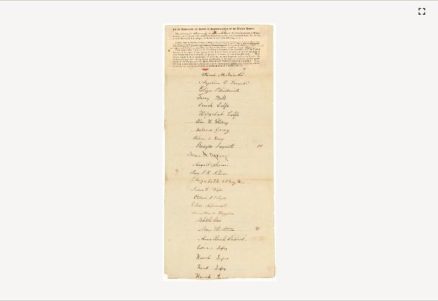
Next, direct students to examine the “Petition Praying that the Gag Rule be Rescinded” using the document analysis questions provided. This activity can be done individually, in pairs, or as a full class. Remind students to click on “View Entire Document” to see additional document details and to read a transcript of the petition.
- Meet the document.
- Observe its parts.
- Try to make sense of it.
- Use it as historical evidence.
Check in with your students at each step in the process and model document analysis if required.
After completing their analysis, students should click on “When You’re Done.” Direct students to the following questions and lead a discussion based on their responses.
- What arguments do the petitioners cite to support their position on the gag rule?
- How do the petitioners draw upon the Bill of Rights to protest the gag rule?
- Why might the right to petition be especially valued by women during this time period?
If needed, as a part of the activity, provide students with the following historical context:
Slavery was such a contentious issue in the 1830s that Congress simply didn’t talk about it. The “gag rule” passed in the House of Representatives in 1836. It automatically tabled (dismissed) all petitions regarding slavery. Under the gag rule, anti-slavery petitions were not read on the House floor, referred to a committee, or printed. No member needed to make a motion for the rule to take effect.
The rule was renewed in each Congress between 1837 and 1839. In 1840, the House passed an even stricter rule, refusing to even accept anti-slavery petitions. The House rescinded the gag rule in 1844 when Representative John Quincy Adams successfully argued that—whatever one’s view on slavery—stifling the First Amendment right to petition was unconstitutional.
Connection to the Declaration of Independence/Bill of Rights: If using this activity as part of a broader civics lesson, explain to students that the Declaration of Independence proclaims that the rights of “life, liberty, and the pursuit of happiness” are unalienable, meaning that they cannot be taken away. Building upon this principle, the Bill of Rights, the first ten amendments to the Constitution, protects individual rights and limits the government’s power. One of these liberties is the right to petition the government established in the First Amendment. This activity demonstrates how Americans used their right to petition to voice their opposition to the gag rule. Additionally, the right to petition established in the Bill of Rights has a direct connection to the Declaration. In the longest section of the Declaration of Independence, colonists submitted facts to a candid world, or a list of grievances, against King George III justifying their decision to declare independence from Great Britain. This served as a way to gain support for their cause from both fellow colonists and other nations who would serve as potential allies. One of these grievances was the King’s failure to address the many petitions the colonists submitted to him and to Parliament.
For additional materials related to Analyzing a Gag Rule Petition (including Guiding Questions, National Standards, Historical Background and Supplemental Educational Resources).

To the extent possible under law, National Archives Foundation has waived all copyright and related or neighboring rights to “Analyzing a Gag Rule Petition”
Description
In this activity, students will carefully analyze a petition sent to the House of Representatives by women from Brookline, Massachusetts protesting against the “Gag Rule” as a violation of their First Amendment rights and asking for it to be rescinded.