


Americans on the Homefront Helped Win World War I

Seeing the Big Picture
Share to Google Classroom
Recommended Activity
Published By:
National Archives Foundation
Historical Era:
The Emergence of Modern America (1890-1930)
Thinking Skill:
Historical Analysis & Interpretation
Bloom’s Taxonomy:
Analyzing
Grade Level:
Middle School
Suggested Teaching Instructions
Learning Objectives
Students will analyze documents related to homefront activities in which Americans were encouraged to engage during World War I. They will compare documents, identify patriotic activities, and reflect on the meaning of American citizenship. For grades 6-8. Approximate time needed is 25 minutes.
Instructions
This activity is intended as an individual student or small-group activity to introduce students to home-front activities during World War I. It could also serve as an introduction and reflection on Veterans Day as a national holiday and/or the meaning of citizenship.
After defining the term “home-front” as it relates to wartime, project the activity for the entire class and choose one document from the grid with which to model document analysis.
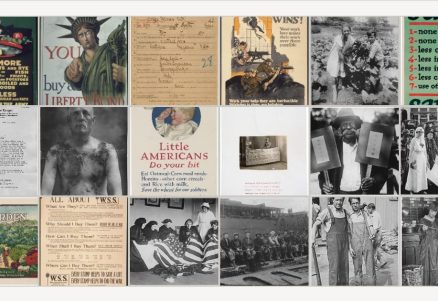
Ask students to complete the activity on their own, performing similar analysis with each document they click on. The activity will instruct students to match the documents according to nine specific ways that Americans were asked to help on the homefront to win the war. (Point out that there may have been other ways to help as well.) Americans could have:
- enlisted or supported relatives who were fighting,
- bought bonds from the government to help finance the war,
- been loyal to the government and told on those who weren’t,
- worked in a wartime industry, even switching from their regular jobs,
- worked instead of staying at home if they were women,
- volunteered skills or time to help the nation or soldiers,
- eaten more of some things and less or none of others,
- saved sugar for the soldiers,
- or grown crops to increase the food supply.
After students make all of the matches, they will see a photograph of an armistice celebration showing cheering and flags of the Allies. Upon learning that Armistice Day became a U.S. holiday to commemorate this event, they will reflect on the purpose of the holiday now known as Veterans Day.
The U.S. Department of Veterans Affairs states the purpose of Veterans Day is “to honor America’s veterans for their patriotism, love of country, and willingness to serve and sacrifice for the common good.”
Following students’ responses to the questions “Do citizens owe their country sacrifices?” and “How much did Americans sacrifice on the homefront during WWI?” in the “When You’re Done” section, conduct a class discussion about sacrifice during wartime and peacetime, and what it means to be an American citizen.

To the extent possible under law, National Archives Foundation has waived all copyright and related or neighboring rights to “Americans on the Homefront Helped Win World War I”
Description
In this activity, students will match photographs, posters, and documents to visualize ways that Americans contributed to the war effort on the home-front during World War I. Students will see a payoff image related to the armistice celebration and reflect on the sacrifices made during wartime.
Share this activity with your students
Documents in this Activity
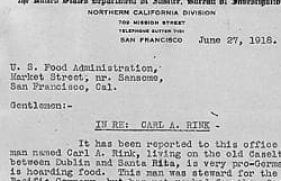
American Protective League to U. S. Food Administration re: Carl A. Rink
The Emergence of Modern America (1890-1930)
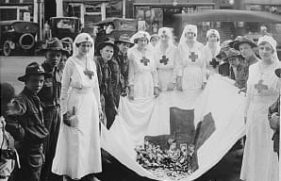
American Red Cross Parade, Birmingham, Alabama. Birmingham View Company
The Emergence of Modern America (1890-1930)

"Yanks and Tommies" During the Armistice Celebration
The Emergence of Modern America (1890-1930)