


American Indian Voting Rights through History

Finding a Sequence
Share to Google Classroom
Recommended Activity
Published By:
National Archives Foundation
Historical Era:
Across Historical Eras
Thinking Skill:
Chronological Thinking
Bloom’s Taxonomy:
Analyzing
Grade Level:
High School
Suggested Teaching Instructions
Use this activity during a unit on American Indian history or the expansion of voting rights. Students will analyze and understand primary sources in context and recognize the length and complexity of the struggle for American Indian voting rights. They can work individually or in pairs. For grades 9-12. Approximate time needed is 45 minutes.
Before you begin the activity, ensure that students are familiar with the term “suffrage” and that they have a basic understanding of voting rights.
Display the activity and click on one of the documents to model document analysis for students. Ask them to use the same steps to understand each document in the activity:
- Meet the document.
- Observe its parts.
- Try to make sense of it.
- Use it as historical evidence.
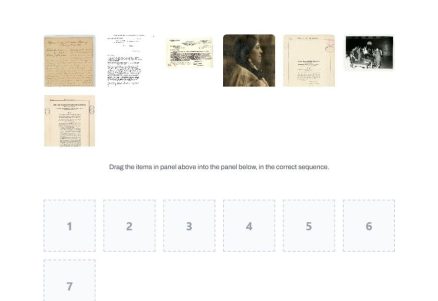
Next, instruct students to open the activity and sequence the documents. Remind students to analyze each document and make a note about what they think it’s saying and why it’s important. Ask students to share and compare these observations in a full-class discussion.
When students have finished, note the different types of records that are included in the history of American Indian voting rights (ex: court cases, photographs, legislative acts). When students click “When You’re Done,” they will be prompted with the following:
- Make a list of some major events in American History that also occurred during this timeline.
- Do you think these events had an impact on American Indian voting rights and the documents in this activity? Why or why not?
Discuss other major events that occurred at the time the documents were created. Make a list using students’ answers. The list may include:
- 1830- The Indian Removal Act was signed into law by President Andrew Jackson.
- 1865- The Civil War ended.
- 1868- The Fourteenth Amendment was ratified.
- 1870- The Fifteenth Amendment was ratified.
- 1888- The Dawes Act was passed.
- 1918- World War I ended.
- 1920- The Nineteenth Amendment was passed, extending suffrage to American women (although minority groups, such as American Indian women, were still excluded; and exclusionary policies such as the Chinese Exclusion Act and actions such as poll taxes limited true universal suffrage.)
- 1929- The Great Depression began.
- 1939- The Great Depression ended and World War II began.
- 1945- World War II ended.
- 1954- In Brown v. Board of Education, the Supreme Court unanimously ruled that separating children in public schools on the basis of race was unconstitutional.
- 1964- The Civil Rights Act of 1964 was passed.
- 1975- The Vietnam War ended.
As a class, discuss the impact that these events may have had on the documents analyzed and the struggle for American Indian voting rights.

To the extent possible under law, National Archives Foundation has waived all copyright and related or neighboring rights to “American Indian Voting Rights through History”
Description
In this activity, students will analyze documents related to American Indian history and voting rights from the 1830s to the 1970s and place them in chronological order. Documents were chosen to show the length of the fight for universal suffrage for American Indians and the different types of records that relate that history.
Share this activity with your students
Documents in this Activity

Marie Louise Bottineau Baldwin
The Emergence of Modern America (1890-1930)

Indian Citizenship Act
The Emergence of Modern America (1890-1930)

Letter About American Indian Voting Rights
Postwar United States (1945 to early 1970s)