

Alfred Sinker and the Writ of Habeas Corpus

Making Connections
Share to Google Classroom
Recommended Activity
Published By:
National Archives Foundation
Historical Era:
Civil War and Reconstruction (1850-1877)
Thinking Skill:
Historical Issues-Analysis & Decision-Making
Bloom’s Taxonomy:
Creating
Grade Level:
High School
Suggested Teaching Instructions
This activity fits into either a teaching unit on the Civil War or one on the court system, since it distinctly outlines the process of a writ of habeas corpus. Unless students already have an understanding of habeas corpus and how a writ of habeas corpus is implemented, this activity is best done as a class to provide the opportunity to explain the process. For grades 9-12. Approximate time needed is 45 minutes.
Note: While the transcriptions make these primary sources more accessible, use the “View Primary Source Details” links to closely examine the documents themselves. This gives students the opportunity to see handwriting and notations that connect them with the people who wrote them.
Begin the activity with the brief history of Alfred Sinker and his family provided in the introduction:
In 1861, during the Civil War, a fifteen-year old boy named Alfred Sinker ran away from his home in Indiana to join the Union Army in Ohio. His regiment was sent to St. Louis, Missouri.
Federal law prohibited the enlistment of boys under 18 without the permission of their parent or guardian. So Alfred’s father, Edward Sinker, came to St. Louis and petitioned in Federal court for a “writ of habeas corpus” — a court order to deliver a person from custody. (Habeas corpus is a protection from unlawful imprisonment since you can challenge the legality of your detainment; it’s part of the U.S. Constitution.)
Judge Samuel Treat found Edward’s case convincing, and issued the writ of habeas corpus. Typically, a writ of habeas corpus demands a prison official or law officer bring a prisoner to court; but in the Sinker case, a military officer delivered Alfred, who was discharged from the Army and returned to his parents.
Ask students to work through each document according to the instructions, answering the questions interspersed between the documents as they go. Explain the stages of the judicial process that are happening, as seen in the documents:
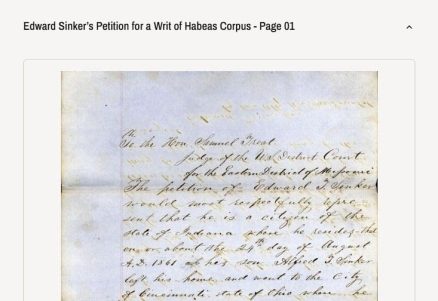
- Edward Sinker’s request for the writ of habeas corpus (his letter to Judge Treat)
- Edward Sinker’s appearance before the district court (District Commissioner)
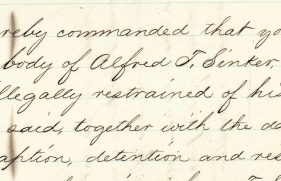
- Judge Treat’s order to deliver Alfred, commanding the writ, sent to Alfred Sinker’s commanding officer
- The officer’s confirmation and implementation of the writ (Robert McDonald’s correspondence)
Discuss the questions in the activity as a class (or in small groups) and choose a student to write down the responses on behalf of the class in the response box.
- What does Edward Sinker’s request tell you about the expectations of a young man in the 1860s Midwest? This question will make students think about the people behind the history, and provide insight into society and family life in the 1860s Midwest as they consider the labor that Edward Sinker expected of his son.
- Why is it important that a judge deliver the order and that the detainee be brought to trial? This question is meant to get students thinking about civil liberties. Learning that a civilian judge, instead of, say, the military, decides the case will help students think about how the law is meant to protect citizens.
- During the Civil War, President Lincoln occasionally suspended habeas corpus…Why do you think President Lincoln did this…Do you agree or disagree with his decision? Depending on student’s knowledge the Civil War, you may need to provide background information to help students understand Lincoln’s concern over the fragility of the Union. This question can be connected to the present-day debate over the balance and conflict between civil liberties and national security.
When you have finished working through the documents and questions, present students with the final task by clicking on “When You’re Done”:
- Imagine you are writing a play about the Sinkers. Write part of the script in which Edward and Alfred have a conversation after Alfred has returned home.
Considering their opposing perspectives will help students think critically about Alfred’s decision to enlist under-aged as well as his ultimate discharge, plus his father’s decision to bring him home. Encourage students to consider the motivations behind each of their actions, and how they likely had mixed feelings during a tumultuous time in American history.

To the extent possible under law, National Archives Foundation has waived all copyright and related or neighboring rights to “Alfred Sinker and the Writ of Habeas Corpus”
Description
In this activity, students will learn about habeas corpus. Specifically, they will look at the case of Alfred Sinker. During the Civil War, the fifteen-year-old ran away from his home in Indiana to join the Union Army in Ohio. Through a writ of habeas corpus, Alfred was discharged from the Union Army and returned to his parents.
Students will reflect on the value of court-issued orders in relation to civil liberties, and they will also gain insight into the expectations of young men during the 1860s.