

African American Soldiers and Civil Rights During WWI

Published By:
Historical Era:
Thinking Skill:
Bloom’s Taxonomy:
Grade Level:
Suggested Teaching Instructions
Use this activity while teaching about World War I or the history of civil rights in the United States. After completion, students should be able to discuss civil rights during WWI through historical examples as illustrated by the different primary sources included in the activity.
Students can complete the activity individually, in small groups or pairs, or in a full-class setting. For grades 7-12. Approximate time needed is 30 minutes.
Prior to beginning the activity, ask students how they would define “civil rights.” Their explanations may vary, so after some discussion, define the term: personal rights guaranteed and protected by the Constitution and Federal law, including protection from unlawful discrimination.
Next, introduce the activity by explaining to students that they will be analyzing documents from American history that illustrate the experiences of African American servicemembers during World War I. (Please discuss with students that these historical sources use the terms “negro” and “colored” to refer to Black people, which were commonly accepted in that era, but are outdated and inappropriate today.)
Open the activity and model document analysis with one of the documents. Ask students to analyze the remaining documents and match each document to its appropriate description. As they work, they should make a list of how African Americans were being denied their civil rights, and think about how to put this treatment into categories.
Students may identify the following categories for the treatment/experiences they see depicted in the primary sources:
- The military was segregated.
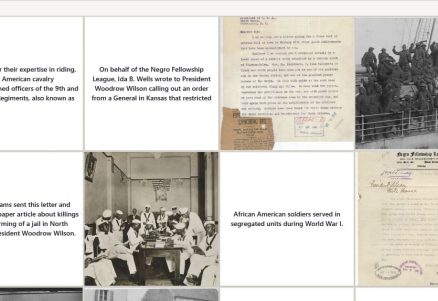
- The photograph of Buffalo Soldiers at West Point shows how Black soldiers were placed in separate “colored” units.
- The photograph of African-American infantrymen in France shows a segregated unit.
- The photograph of the American Red Cross Rest Room for African American Soldiers and Sailors shows segregated facilities.
- American society was segregated.
- The 369th Infantry (seen arriving home) was prohibited from participating in the farewell parade when they deployed in 1917.
- The letter from Ida B. Wells-Barnett to President Woodrow Wilson discusses an order that soldiers of color not go into public places where their color would be “resented.”
- There was racial violence and lynching.
- The letter to President Woodrow Wilson describes a lynching in North Carolina.
After students have finished making all of the matches, they will see a letter written by an African American veteran, discussing his experience after World War I.
Students should click on “When You’re Done” and answer the questions provided in preparation for a class discussion:
- What kinds of arguments do the letters make? What references to the war do they use? Why do you think the authors felt this reasoning would be effective
- The final letter states that the writer is still fighting for Constitutional rights. What civil rights were denied to African Americans in the period following World War I? How were African Americans discriminated against?
Share the following background information with students:
By the end of World War I, nearly 370,000 African Americans had served in the war effort in some capacity. Discriminatory practices such as segregation affected what branches of the military and services were open to enrolled African Americans. After their valorous actions at home and abroad, and in support of American victory in the war, African Americans were still denied rights and protections after the war. “Jim Crow” laws and election laws and procedures were implemented to block Black communities from voting, despite the 14th and 15th Amendments.
However, the World War I experiences of African American soldiers set the stage for the continued fight for civil rights, led by activists, African American veterans, and Black leaders.

Description
In this activity, students will analyze documents and match them to their descriptions to learn about struggles for civil rights for African Americans during World War I. They will reflect on arguments made in favor of stronger protections for civil rights, as well as what types of rights were denied to African Americans in the period following the war.

