

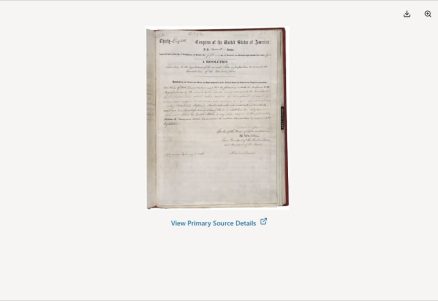

13th Amendment Document Analysis

Analyzing Documents
Share to Google Classroom
Published By:
TEST TEST
Historical Era:
Civil War and Reconstruction (1850-1877)
Thinking Skill:
Historical Analysis & Interpretation
Bloom’s Taxonomy:
Analyzing
Grade Level:
Middle School, High School
Suggested Teaching Instructions
This activity is appropriate in a US History unit related to the abolitionist movement, the Civil War, and slavery. For grades 7-12. Approximate time needed is 20 minutes.
It can be done individually, in pairs, or as a full class. Direct students to begin by taking a minute to examine the document, then responding to the questions.
Students should answer the questions below the document, which will guide them through the process of written document analysis. If necessary, check in with your students at each step in the process and model analysis if required:
- Meet the document.
- Observe its parts.
- Try to make sense of it.
- Use it as historical evidence.
After students have answered all of the analysis questions, direct them to the following resources for additional historical context.
- Milestone Documents: 13th Amendment to the U.S. Constitution
- Resolution Proposing the Thirteenth Amendment to the U.S. Constitution
- Abolishing Slavery: Two 13th Amendments
- From Slavery to Juneteenth: Emancipation and Ending Enslavement
- Comparing and Contrasting the Emancipation Proclamation, the 13th Amendment and General Order No. 3
After exploring the historical context, they should click on “When You’re Done” and answer the following:
- What actions taken by abolitionists led to the the passage of the 13th Amendment?
- What historical events helped support passage of the 13th Amendment?
The 13th Amendment is a part of America’s 100 Docs, an initiative of the National Archives Foundation in partnership with More Perfect that invites the American public to vote on 100 notable documents from the holdings of the National Archives. Visit 100docs.vote today. For a culminating activity involving 16 of America’s 100 Docs, visit the activity America’s 100 Docs: Sweet Sixteen Bracket.

To the extent possible under law, TEST TEST has waived all copyright and related or neighboring rights to “13th Amendment Document Analysis”
Description
In this activity, students will carefully analyze the the 13th Amendment to the US Constitution which abolished slavery.