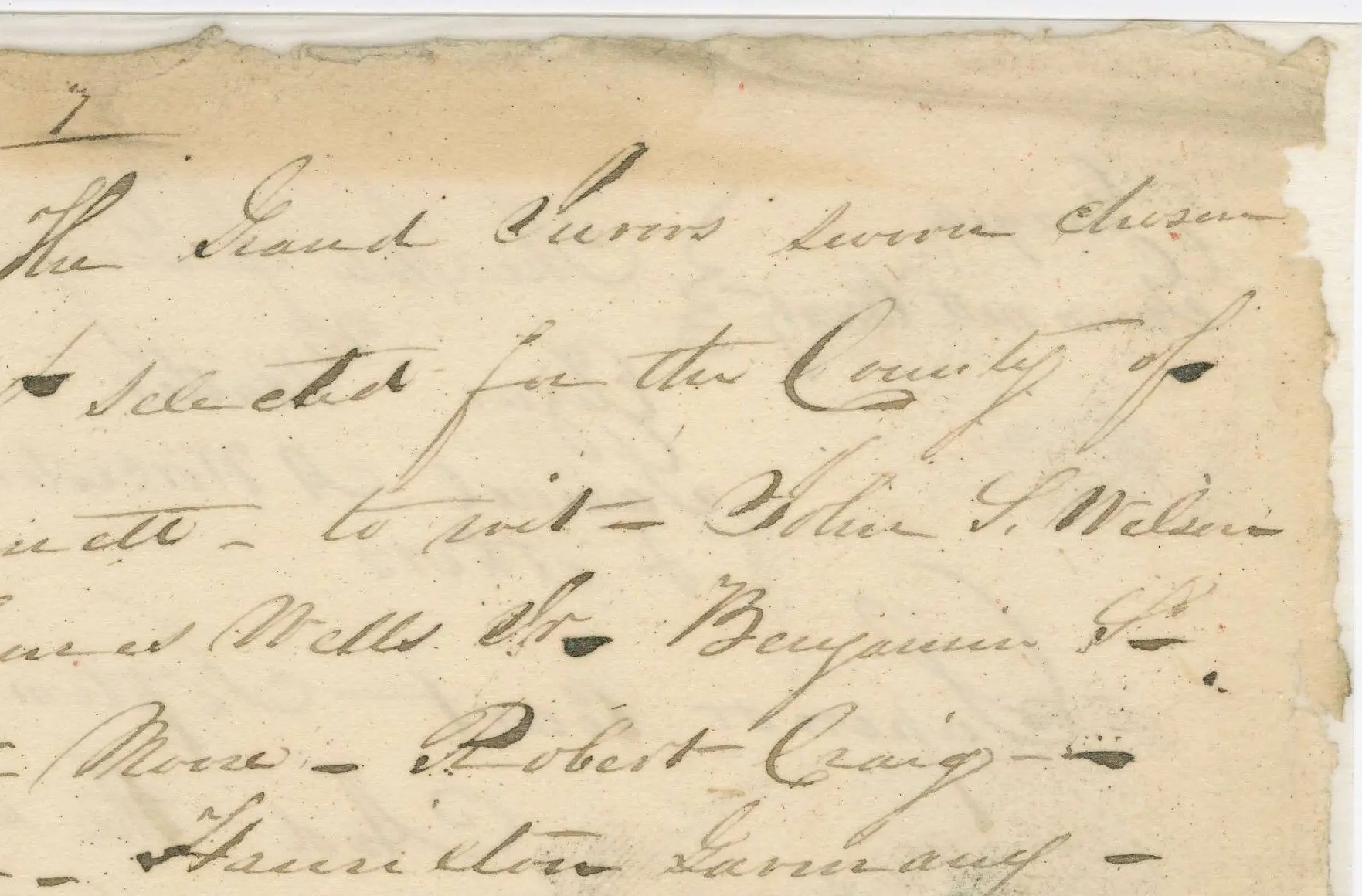
In 1830, Georgia passed a law requiring non-Cherokee to obtain a permit from the state of Georgia to reside on Cherokee land. A group of missionaries, including Samuel Worcester and Elizur Butler, went to live on Cherokee land with permission from the Cherokee Nation and the U.S. Government.
Georgia charged Worcester, Butler, and the rest of the defendants with violating state law by residing in Cherokee territory without a permit and failing to swear an oath to the constitution and laws of the State of Georgia. This document is the grand jury’s indictment of the missionaries. It comes from the case file for Worcester v. Georgia.
The defendants pleaded not guilty, but the Superior Court of Gwinnet in Georgia found them guilty and sentenced them to four years of hard labor. The men appealed. After they were unsuccessful in the highest state court, they appealed to the U.S. Supreme Court on a writ of error (which demands the lower court provide the full record to a higher court for review of errors) in Worcester v. Georgia.
The Federal question raised (necessary to appeal to the U.S. Supreme Court) was whether the state of Georgia had jurisdiction, since the men were present in the territory under authority of the U.S. President doing missionary work, and with the permission of the Cherokee Nation. In other words, did the state of Georgia have the authority to hear the case or to pass laws concerning sovereign Indian nations?
The question had been asked of the Supreme Court before. In 1828, Georgia had passed a series of acts taking away rights of Cherokees residing within the state, including Cherokee removal from land that the state wanted. The Cherokee asserted that Georgia did not have the jurisdiction or authority to do these things, since the Cherokee Nation was sovereign and protected under a treaty with the United States. They sought an injunction — or order to stop what the State of Georgia was doing — from the U.S. Supreme Court in Cherokee Nation v. Georgia in 1831. The Supreme Court said they lacked jurisdiction to hear the case and it was dismissed, leaving the Cherokee at the mercy of the laws of the state of Georgia.
In Worcester v. Georgia in 1832, however, the Supreme Court ruled that states, like Georgia, could not diminish rights of tribes because the Cherokee Nation constituted a nation holding distinct sovereign powers as granted by Congress and the United States. This established the principle of “tribal sovereignty.” The Court also issued a mandate to release Worcester and Butler.
Georgia ignored the ruling, however, and did not release the men. President Andrew Jackson did not intervene to enforce the Supreme Court ruling. (Georgia Governor Wilson Lumpkin pardoned Butler and Worcester in 1833.)
So the judicial branch handed down a ruling that should have freed Butler and Worcester and established more sovereignty for the tribes; but it didn’t have that effect because the executive branch did not enforce it.
President Andrew Jackson had called for the relocation of eastern Native American tribes to land west of the Mississippi River, and Congress had passed the Indian Removal Act, in 1830. The Cherokee were forcibly removed from Georgia — a journey west that became known as the “Trail of Tears” because of the thousands of deaths along the way.
This document was digitized by teachers in our Primarily Teaching 2016 summer workshop in Washington, D.C.