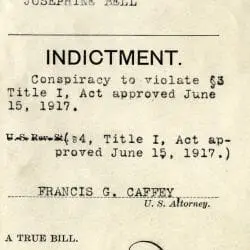
This is the indictment for violation of Section 3, Title I, of the “Espionage Act approved June 15, 1917, relative to the state of war with Germany,” against defendants: The Masses Publishing Company, Max Eastman, Floyd Dell, C. Merril Rogers Jr., Henry J. Glintenkamp, Arthur Young, John Reed, and Josephine Bell. The indictment states they conspired to cause the “insubordination, disloyalty, mutiny, and refusal of duty in the military and naval forces of the United States.”
The socialist magazine The Masses was dedicated to “radical art and freedom of expression.” For the August 1917 issue, the editors, artists, and writers crafted pieces that showed disapproval for America’s involvement in World War I. This was dangerous was due to the recent passage of the Espionage Act that made it illegal to make any statements that would interfere with the military operations, promote the success of the enemy, cause insubordination by soldiers or obstruct the draft. The maximum sentence was 20 years in prison. The act also gave the Post Office the power to seize any controversial periodical that went through the mail as “non-mailable.” The Masses August issue was seized by New York City’s Postmaster T. G. Patten. In the only court case that supported freedom of the press during WWI, Judge Learned Hand agreed with The Masses and supported their right to publish by saying nothing within the journal directly advocated resistance to the law.
The Government appealed and indicted seven staff members of The Masses for espionage. After two hung juries and with the war already over, the government decided to stop prosecution in the case.
The Federal Government made over 2,000 arrests and 1,000 convictions in relation to the Espionage act, commonly called the Sedition Act.