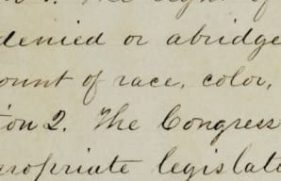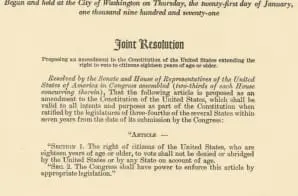
Senate Joint Resolution 7 proposed an amendment to the Constitution that would extend the right to vote to citizens 18 years of age or older. Introduced on January 21, 1971, during the first session of the 92nd Congress, it became the 26th Amendment to the Constitution. A joint resolution is a formal opinion adopted by both houses of the legislative branch. A constitutional amendment must be passed as a joint resolution before it is sent to the states for ratification.
The 26th Amendment was ratified in 100 days, faster than any other amendment. In April 1970, Congress had controversially lowered the voting age to 18 as part of legislation to extend the Voting Rights Act of 1965. Many people, including President Richard Nixon, believed that it was the right of the states, not the federal government, to set the voting age. President Nixon, nevertheless, signed the act, which was to go into effect January 1, 1971.
The effort to lower the voting age to 18 had begun three decades earlier. “Old enough to fight, old enough to vote,” a slogan first heard during World War II, was adopted by student activists during the Vietnam War.
In 1942, the slogan prompted Congressman Jennings Randolph of West Virginia to propose an amendment to the Constitution lowering the voting age to 18. Presidents Dwight D. Eisenhower and Lyndon B. Johnson both championed the cause. Activists during the Vietnam War increased pressure on Congress to change the voting age, and in 1971, when Senator Randolph reintroduced his original proposal, it passed overwhelmingly.
On December 21, 1970, the Supreme Court ruled that the government had indeed overstepped its legislative bounds in lowering the voting age. Fearing mass confusion over who could vote in the 1972 election, Congress quickly moved to pass the 26th Amendment. Ratification by the states was accomplished in a record four months.
The 26th Amendment is a part of America’s 100 Docs, an initiative of the National Archives Foundation in partnership with More Perfect that invites the American public to vote on 100 notable documents from the holdings of the National Archives. Visit 100docs.vote today.