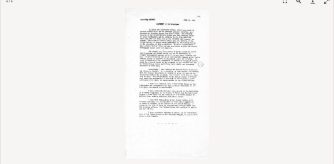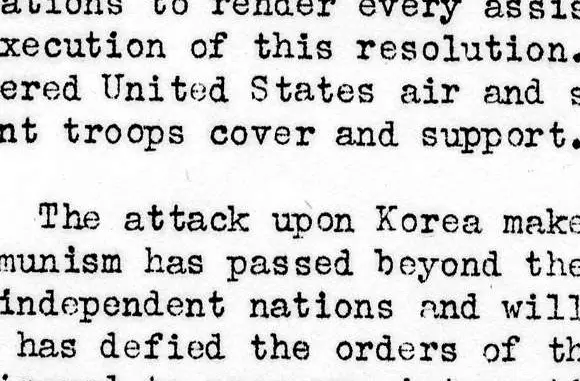
In this press release, President Truman announced that he was committing American forces to a combined United Nations military effort in Korea. The decision was made after war broke out along the 38th parallel on June 25, 1950. On that day, North Korean troops coordinated an attack at several strategic points along the parallel and headed south toward Seoul.
Truman’s statement illustrates his concern with communist aggression and expansion. He argues that “communism has passed beyond the use of subversion to conquer independent nations and will now use armed invasion and war.” He informed his advisors that he believed the invasion was “very obviously inspired by the Soviet Union.” This gave America a moral imperative to act. “If we don’t put up a fight now,” Truman observed to his staff, there was “no telling what they’ll do.” His statement shows his concern about the future of anticommunist governments in Asia: he pledged to defend Formosa (Taiwan) from attack, and to support French forces in Indochina (a conflict that would eventually escalate into the Vietnam War).
Truman had met with his advisors on the morning of June 27th to draft and revise this public statement. At 11:30 a.m., he met with members of the foreign affairs and foreign relations committees of Congress; shortly after, the statement was released to newspaper reporters. That afternoon, Truman attended a meeting of the United Nations to propose a resolution urging all U.N. member countries to give assistance to South Korea. The meeting had been originally planned for the morning but was postponed to accommodate one of its members. Secretary of State Dean Acheson later reflected that the Soviets liked to point out that since the U.N. meeting occurred after the President’s statement, Truman could not truthfully claim that his decision to commit forces was influenced by the wishes of the United Nations.
When it did meet later that day, the United Nations passed Truman’s resolution, although a handful of dissenting countries abstained. The resolution condemned North Korea’s invasion as a “breach of the peace.” In addition to the United States, 15 other nations also sent troops to Korea. Truman did not seek a formal declaration of war from Congress; officially, America’s presence in Korea was a “police action.”