In their quest to establish colonies in the “New World,” Britain and France competed for the allegiance of the powerful Iroquois Confederacy, then also known as the Five Nations. In 1722, the governors of New York, Pennsylvania, and Virginia converged on Albany, New York, to conduct diplomacy with Iroquois leaders.
At the treaty council, New York Governor William Burnet enjoined the Iroquois to cease contact with New France (modern-day Canada), Britain’s North American colonial rival. Although the Iroquois delegates vowed to “cleave close” to the British, they made no promise to rebuff the French. Doing so would have violated their policy of neutrality.
Virginia governor Alexander Spotswood came to Albany to ask the Five Nations to avoid lands south of the Potomac River and east of the Blue Ridge Mountains. This would prevent Iroquois war parties from encountering Euro-American settlers and small Native communities along Virginia’s frontier. The Iroquois agreed to observe the boundary in exchange for 20 guns and 500 flints.
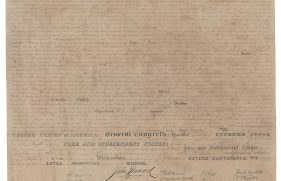
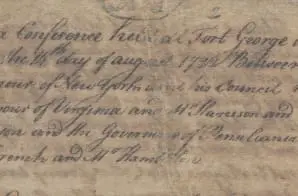
Pages 1-4 of this document are shown here. See the entire document in the National Archives online catalog.