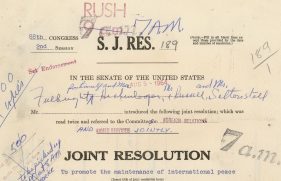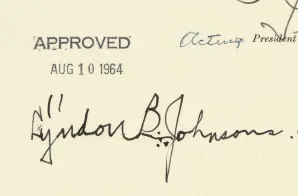
This is Public Law 88-408, Joint Resolution for the Maintenance of Peace and Security in Southeast Asia, that was passed by Congress and signed by President Lyndon B. Johnson. This is a “ceremonial copy” of the Public Law from the Lyndon B. Johnson Museum Collection.
Congress passed the Tonkin Gulf Resolution with the understanding that U.S. ships had been attacked twice in international waters in the Gulf of Tonkin near North Vietnam. They gave Johnson unprecedented power to “take all necessary measures to repel any armed attack against the forces of the United States and to prevent further aggression.”
There was little debate as legislators considered two incidents that had happened in the preceding days. On August 2 – the first Tonkin Gulf incident – North Vietnamese torpedo boats were spotted and attacked the destroyer USS Maddox. The Maddox was conducting electronic eavesdropping on North Vietnam to assist South Vietnamese Army (ARVN) commando raids on North Vietnamese targets, but that wasn’t publicly known at the time. Historians now suspect the North Vietnamese boats had set out to attack an ARVN raid in progress when it encountered the Maddox.
On August 4, the USS Maddox captain reported a second incident, that he was “under continuous torpedo attack.” He later cabled “freak weather effects on radar and overeager sonarmen may have accounted for many reports,” but Defense Secretary Robert McNamara did not report the captain’s doubts to President Johnson. (A 2002 National Security Agency report made available in 2007 confirmed the August 2 attack, but concluded the August 4 attack never happened.)
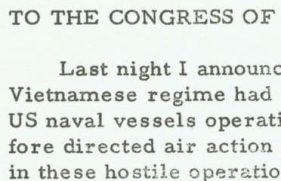
Johnson portrayed confrontations between U.S. and North Vietnamese ships off the coast of North Vietnam as unprovoked aggression. When contrary information surfaced, many believed Congress had been conned. It was too late.
The Gulf of Tonkin act became more controversial as opposition to the war mounted. A Senate investigation revealed that the Maddox had been on an intelligence mission in Tonkin Gulf, contradicting Johnson’s denial of U.S. Navy support of such missions. The Resolution was repealed in 1971 in an attempt to curtail President Nixon’s power to continue the war.
Tonkin Gulf Resolution is a part of America’s 100 Docs, an initiative of the National Archives Foundation in partnership with More Perfect that invites the American public to vote on 100 notable documents from the holdings of the National Archives. Visit 100docs.vote today.