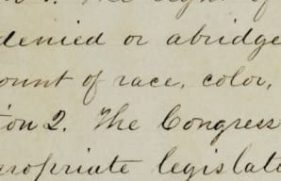
This is a draft of a joint resolution proposing the 13th Amendment to the United States Constitution that started in the Senate. A joint resolution is a formal opinion adopted by both houses of the legislative branch. A constitutional amendment must be passed as a joint resolution before it is sent to the states for ratification. This particular resolution became the 13th Amendment, ending slavery in the United States in 1865.
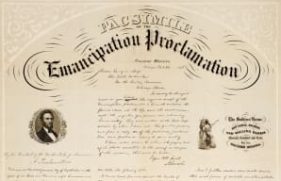
In 1863, President Lincoln had issued the Emancipation Proclamation declaring “all persons held as slaves within any State, or designated part of a State, the people whereof shall then be in rebellion against the United States, shall be then, thenceforward, and forever free.” Nonetheless, the Emancipation Proclamation did not end slavery in the nation since it only applied to areas of the Confederacy currently in a state of rebellion (and not even to the loyal “border states” that remained in the Union). Lincoln recognized that the Emancipation Proclamation would have to be followed by a constitutional amendment in order to guarantee the abolishment of slavery.
The 13th Amendment was passed at the end of the Civil War before the Southern states had been restored to the Union, and should have easily passed in Congress. However, though the Senate passed it in April 1864, the House initially did not. At that point, Lincoln took an active role to ensure passage through Congress. He insisted that passage of the 13th Amendment be added to the Republican Party platform for the upcoming 1864 Presidential election. His efforts met with success when the House passed the bill in January 1865 with a vote of 119–56.
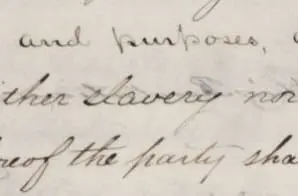
On February 1, 1865, President Abraham Lincoln approved the Joint Resolution of Congress submitting the proposed amendment to the state legislatures. The necessary number of states (three-fourths) ratified it by December 6, 1865. The 13th Amendment to the United States Constitution provides that “Neither slavery nor involuntary servitude, except as a punishment for crime whereof the party shall have been duly convicted, shall exist within the United States, or any place subject to their jurisdiction.”
With the adoption of the 13th Amendment, the United States found a final constitutional solution to the issue of slavery. The 13th Amendment, along with the 14th and 15th, is one of the trio of Civil War amendments that greatly expanded the civil rights of Americans.
The 13th Amendment is a part of America’s 100 Docs, an initiative of the National Archives Foundation in partnership with More Perfect that invites the American public to vote on 100 notable documents from the holdings of the National Archives. Visit 100docs.vote today.