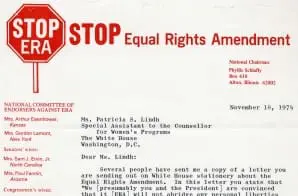
The Equal Rights Amendment (ERA) sparked a long and divisive struggle when it was introduced. Some believed it would provide full equality for women. Others considered it unnecessary. First proposed in 1923, the ERA would add to the Constitution that women have equal rights with men. It was introduced at every session of Congress until 1972, when it passed both houses and was sent to the states for ratification.
After Congress passed the ERA, lawyer Phyllis Schlafly launched the STOP ERA campaign. Believing the ERA was vague and unnecessary, and that making law gender-neutral was detrimental to families and to the United States, Schlafly fought against the ERA until its final deadline. When the deadline for ratification passed in 1982, the amendment was three states shy of the requisite number of votes.