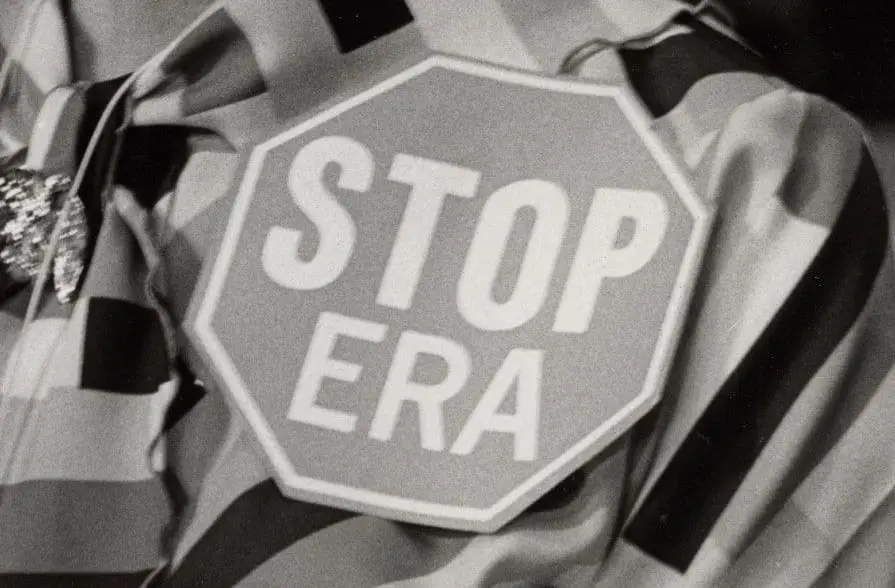
This photograph shows an unidentified woman wearing a “STOP ERA” badge at the National Women’s Conference in Houston, Texas. At the conference, 2,005 state delegates recommended to Congress and the President how to advance women’s rights. Delegates adopted a 26-plank national plan, addressing issues such as career interests, rights for minority women, and the Equal Rights Amendment.
Susan B. Anthony’s nephew, Congressman Daniel R. Anthony, first introduced H.J. Res. 75 proposing an Equal Rights Amendment (ERA) in 1923. Drafted by Alice Paul, a leader in the fight for women’s rights, the ERA was introduced in Congress as a way to end discrimination against women. This controversial amendment was reintroduced at every subsequent session of Congress for 49 years. Supporters believed it would provide full equality for women; opponents considered it unnecessary, and some believed it destructive of the family.
Led by Phyllis Schlafly, STOP ERA organized quickly, arguing that the ERA would hurt women and families. With a coalition of traditional family and “protectionist” supporters, STOP ERA worked to prevent ratification. In 1972 the amendment passed both houses of Congress but fell three states short of the requisite number of votes (three-fourths of states) for ratification.