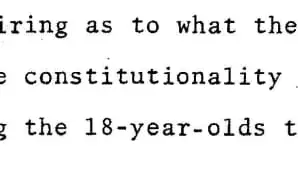
Attorney General John N. Mitchell made this statement about the constitutionality of legislation passed by Congress that would give 18-year-olds the right to vote.
In April of 1970, Congress had controversially lowered the voting age to 18 as part of legislation to extend the Voting Rights Act of 1965. The Voting Rights Act of 1965 had outlawed the discriminatory voting practices adopted in many southern states after the Civil War, including literacy tests as a prerequisite to voting. The act was readopted and strengthened in 1970, 1975, and 1982.
Many people, including President Richard Nixon, believed that it was the right of the states, not the federal government, to set the voting age. President Nixon, nevertheless, signed the act, which was to go into effect on January 1, 1971.
The effort to lower the voting age to 18 had begun three decades earlier, during World War II. Pressure on Congress to change the voting age increased during the Vietnam War. In 1971, Senator Jennings Randolph proposed an amendment to the Constitution lowering the voting age to 18 (one which he had originally proposed as a Congressman in 1942). It passed overwhelmingly.
On December 21, 1970, the Supreme Court ruled that Congress had overstepped its bounds in lowering the voting age through legislation. Fearing mass confusion over who could vote in the 1972 election, Congress quickly moved to pass the 26th Amendment, giving 18-year-olds the right to vote. Ratification by the states was accomplished in a record four months.
This document also includes pages of questions from reporters with responses on topics such as the Voting Rights Act of 1970, Vietnam war protests, freedom of speech, the Black Panthers, the campaign to impeach Supreme Court Justice William O. Douglas, criminal justice legislation including the D.C. Crime Bill and No-Knock Bill, school desegregation, government surveillance, organized crime, the war on drugs, and the relationship between the Nixon administration and Black Americans.