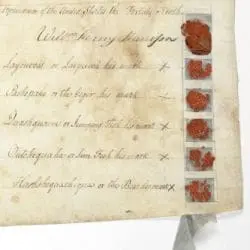
This handwritten treaty between the U.S. Government and the Sauk (or Sac) and Fox Indians was signed at St. Louis, Missouri, in the District of Louisiana on November 11, 1804. William Henry Harrison was the representative and signer for the United States. It is also called Ratified Indian Treaty #43, 7 STAT 84, or the Treaty of St. Louis.
After the Revolutionary War, the United States had continued the European practice of negotiating treaties with the Native Peoples similarly to how they negotiated with foreign governments. This practice changed gradually over time.
In 1831, the Supreme Court case Cherokee Nation v. Georgia changed the status of Native tribes from “independent, sovereign nations” to “domestic dependent nations.” Treaties, however, still followed the pattern of requiring negotiations between the U.S. Government and tribal governments and ratification by Congress. Not all negotiated treaties were ratified.
In 1871, Congress passed the Indian Appropriations Act, which suspended all further treaties with Native governments. After that time, all changes or additions to Native lands or status were conducted by Executive Order, Acts of Congress, and decisions of the Federal Courts. To this day federally recognized American Indian tribes and Alaska Natives retain the right of self-government and usually hold a legal position directly under the Federal Government.