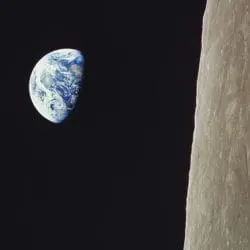
On December 21, 1968, the three-man crew aboard the Apollo 8 spacecraft—Frank Borman, Jim Lovell, and Bill Anders—lifted off from Cape Kennedy and began a journey that would take them farther away from Earth than anyone had ever gone. Their mission was a crucial step in the Government’s program to land a man on the Moon by the end of the 1960s. They were to travel some 240,000 miles from Earth, enter lunar orbit, scout for appropriate landing sites, and prepare the way for future lunar-landing missions. The crew was armed with still and movie cameras to photograph the Moon; but the most enduring image of their mission is this photograph of their own home, planet Earth. According to Anders, the astronauts saw the horizon vertically—not horizontally—with the lunar surface to the right. The flight plan called for the crew to broadcast a public message from lunar orbit on Christmas Eve. The audience was half a billion people around the world. After describing the desolation and bleakness of the lunar landscape, the astronauts read from an ancient text they had brought with them: “In the beginning, God created the heaven and the earth,” Anders began. Each of the three astronauts read in succession the first ten verses from the book of Genesis, with Frank Borman, commander of the mission, concluding the broadcast, “And from the crew of Apollo 8, we close with good night, good luck, a merry Christmas, and God bless all of you—all of you on the good Earth.”