The construction of a memorial to President Abraham Lincoln in Washington, DC, was first approved by Congress in 1911. The bill authorizing the construction created the Lincoln Memorial Commission to approve a site and a design for a memorial honoring the 16th President. The Committee was given a budget of $2 million dollars, the largest amount to ever be provided for a national memorial at the time.
John Russell Pope and Henry Bacon were the front runners in the selection of the architect for the Lincoln Memorial. Pope, one of the most famous American neoclassical architects, believed that a democracy’s public buildings should be designed in the style of the ancient Greeks and Romans. Today, Pope’s designs are scattered throughout the city of Washington, and include the Jefferson Memorial, the National Gallery of Art, and the National Archives.
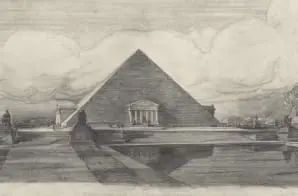
Pope submitted several design ideas. The one seen here is a pyramid style structure. Pope’s final proposed design was an enormous monument, circular in shape.
In the end, the Commission of Fine Arts awarded Henry Bacon the job. Though the structures Pope designed for the Lincoln Memorial were never constructed, they were widely appreciated at the time. His designs were released and displayed by prestigious architects clubs in 1914 and received a great deal of interest and admiration from the public.