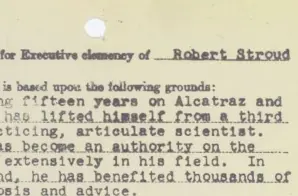
We undersigned, respectfully endorse the petition for Executive clemency of Robert Stroud
Our approval is based upon the following grounds:
Prisoner Stroud has worked during fifteen years on Alcatraz and twenty-one years in Leavenworth. He has lifted himself from a third grade education to the level of a practicing, articulate scientist.
Under difficult conditions he has become an authority on the diseases of birds. He has published extensively in his field. In the years he was allowed to correspond, he has benefited thousands of birdlovers with encouragement, diagnosis and advice.
For the last 38 years, prisoner Stroud has committed no act of violence. He is not psychotic. All of his good conduct credit has been allowed. He has equipped himself to work in the world without becoming a public charge. Nor should his brusque and at times irritating mode of expression be permitted to obscure the long and impressive evidence of responsible and productive behavior. We feel that his release cannot any longer be considered a threat to society and that he has earned commutation to time served.
These considerations are grounds enough for our approving the release of any deserving man. But in addition, there is a deeper, more troubling aspect to this case.
Prisoner Stroud was given his life by a U.S. President, Woodrow Wilson. Stroud seems to have done what he could under difficult conditions, to return the debt over a period of 38 years.
In this deeper sense we believe that his prisoner should be released, not because of his advanced age, not because of the severity of his long punishment, but because of the ideals and principles of society as we live it, the most advanced country on earth. Our expressed principles of penology are offended by the prolonged character of this man’s confinement alone. These principles spell out some reward even for the least of us when it is earned. The fruits of effort call for recognition when we improve ourselves and try to be of use. This is a cornerstone of modern penology: rehabilitation.
Prisoner Stroud’s life changed when his life was spared. It seems not to have been a change from expediency, nor from contrition. It was not a religious conversion, not even done from the deliberate will of the prisoner, whatever he may say or believe.
He had in him a spark that responded through nature itself, when he accidentally came into contact with sick, helpless birds. He earned to doctor them and he became, through them, of use to society.
It is in view of these basic matters involving all of us, that we believe society will be best served by terminating the ordeal of this prisoner at the earliest feasible and reasonable date.
NAME I RESIDENCE I OCCUPATION