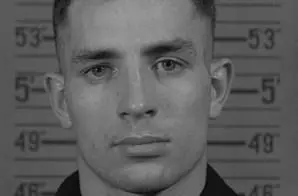
Jack Kerouac—American counterculture hero, icon of the Beat Generation, and author of On the Road—was a Navy military recruit who failed boot camp. This personnel file includes Kerouac’s application for enlistment, birth certificate, letters of reference, and medical reports that ultimately led to the conclusion that he was “unfit for service.”
Kerouac enlisted in the U.S. Navy Reserve (then called the U.S. Naval Reserve) during World War II. But he never completed basic training. After only 10 days in boot camp, he was referred to the sick bay and then to the psychiatric ward.
Born and raised in Lowell, Massachusetts, Kerouac completed high school there, then spent an additional year of high school at Horace Mann Prep in New York on a full scholarship. He continued on to Columbia University on a football scholarship, but quit college to enter the merchant marine, which he left after three months. On December 8, 1942, Kerouac enlisted in the U.S. Naval Reserve for a four-year term of duty.
In a letter of recommendation from November 1942, Horace Mann Prep principal Charles C. Tillinghast said Kerouac had “a most excellent reputation. His academic record was in every way satisfactory, and his record for character and citizenship was of the finest. …I am sure that he will be found loyal and dependable in any position of responsibility.”
Kerouac’s French instructor at Columbia “found him…extremely capable, possessed of a refreshingly alert intellectual capacity and an ability to think independently.” He wrote, “He is a young man of fine moral character and good breeding. His self-reliance and resourcefulness have been demonstrated by his ability to fend for himself, and give evidence of the qualities of leadership you are undoubtedly seeking among your candidates.”
Through their extensive medical and psychiatric evaluations, however, Navy doctors found Kerouac delusional, grandiose, and promiscuous, and questioned his strange writing obsession. They viewed “patient’s occupation as a writer” as a sign of mental imbalance because “Without any particular training or back ground, this patient, just prior to his enlistment, enthusiastically embarked upon the writing of novels. He sees nothing unusual in this activity.”
Kerouac hated being “disciplined to death” and forbidden to smoke at breakfast. He despised the work details. Kerouac later summarized in a semi-autobiographic novel: “I was just about the least military guy you ever saw…”
On June 2, 1943, the Navy completed its evaluation and diagnosed Kerouac with “Constitutional Psychopathic State, Schizoid Personality.” The schizoid trends “have bordered upon but have not yet reached the level of psychosis, but which render him unfit for service.”
The doctors suggested his discharge, and Kerouac signed a form stating that this condition was a preexisting one. On June 10, it was recommended that Kerouac be discharged “for reason of unsuitability rather than physical or mental disability.” Kerouac’s military duty was officially terminated on June 30, 1943 “by reason of Unsuitability for the Naval Service.”
He spent the rest of his life running from structure, discipline, rules, regulations, and authority. The further he ran, the more he was embraced as a countercultural icon and embodiment of a new “Beat” way of life.
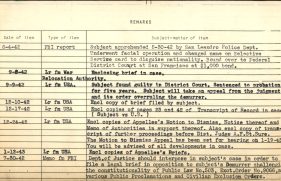
Select pages from this personnel file are shown. You can view the entire file in the National Archives Catalog.