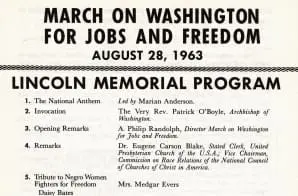
This program listed the events scheduled at the Lincoln Memorial during the August 28, 1963, March on Washington for Jobs and Freedom. The highlight of the march, which attracted 250,000 people, was Martin Luther King’s “I Have a Dream” speech.
The idea for the 1963 March on Washington was conceived by A. Philip Randolph, a long-time civil rights activist dedicate to improving the economic condition of Black Americans. He saw the March on Washington as a great opportunity to unify all of the major civil rights organizations and improve economic opportunities.
When Randolph first proposed the march in late 1962, he received little response from other civil rights leaders. He knew that cooperation would be difficult because each had his own agenda for the civil rights movement, and the leaders competed for funding and press coverage. Success of the March on Washington would depend on the involvement of the so-called “Big Six”—Randolph and the heads of the five major civil rights organizations: Roy Wilkins of the National Association for the Advancement of Colored People (NAACP); Whitney Young, Jr., of the National Urban League; Rev. Martin Luther King, Jr., of the Southern Christian Leadership Conference (SCLC); James Farmer of the Conference of Racial Equality (CORE); and John Lewis of the Student Nonviolent Coordinating Committee (SNCC).
The details and organization of the march were handled by Bayard Rustin, Randolph’s trusted associate. Rustin was a veteran activist with extensive experience in putting together mass protests. With only two months to plan, Rustin established his headquarters in Harlem, NY, with a smaller office in Washington. He and his core staff of 200 volunteers quickly put together the largest peaceful demonstration in U.S. history.
The “Big Six” quickly spread the news through press conferences and speeches, while Rustin worked through the civil rights and labor organization to mail thousands of flyers to churches, fraternal societies, labor unions, civic groups, youth groups, and professional associations. The flyers emphasized the peaceful nature of the March and focused on the unifying goals of the Civil Rights Movement. A list of the marchers’ demands included meaningful civil rights laws, full and fair employment, decent housing, the right to vote, and adequate and integrated education. Soon thousands of people sent letters to the March headquarters expressing their interest.