[page 1]
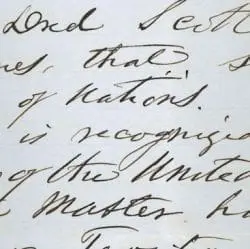
- The Dred Scott Case 19 How. 393 determines, that, slavery exists by the law of nations.
- That, it is recognized by the Constitution of the United States.
- That, the Master has a right to take his slave to any Territory of the United and hold him in slavery, and that, Congress has no power to infringe this right.
- That, Africans are not citizens.
- That the status of the slave depends upon the laws of the state, where the master has his domicil.
- That, if a slave is taken to a free state, by his master, and again take back to a slave state, that, he does not thereby become free, but still remains a slave. 19 How. 427.
It seems to me clear, that, if Archy was a slave in Miss. and made his escape, that, his master might recapture him in any state, or Territory in the Union and return with him to his domicil, or any other slave state. It cannot affect, the status of the slave, that, he retaken in a slave state, and taken home through a slave state. He might be recaptured in Maine, or Maryland and taken through any other State in the Union, before he reaches his domicil. The master is bound to no time nor any directness of route. He can take his own time and his own roads, if he intends in good faith to return.
[page 2]
It is absurd to suppose, that, taking the fugitive through a slave state, or any number of free or slave states can affect the question in any way. Neither can the status of the slave on his way back, be changed by a temporary sojourn of the master, if it be a sojourn and not a settlement with a aim of acquiring a new domicil.
Stoval was a native of Miss. Nothing is better settled than that, the Domicil of origin obtains until a new one is acquired. In the case of De Bonneval vs De Bonneval 1 Curtis, being C. Eng: Ecclesiastical Reports, 498. in part held: “the domicil of origin continues until another is acquired, and a new domicil is not acquired by residence unless it be with an intention of abandoning the former domicil. A French man having quitted France in 1792 in consequence of the revolution there, and having resided in England until 1814, when he returned to France and afterwards occasionally resided in both countries –Held, not to have abandoned his domicil of origin.” Chancellor Kent : 2 Com: p. 431. says: “there must be intention and act united to effect a change of domicil.”
[page 3]
The residence of Stoval in California for the recovry of health, or temporary employment to raise means to enable him to return with his slave would not affect the status of the slave, or the right of the master, any more that a forcible detention of the master by a public enemy. The only question is did he have the animo revertendi?
If the master was returning through California, and the slave escaped it cannot admit of doubt, that, he would be a fugitive from labor under the act of the Legislature of 1850, Calif Law p. 231; as well as under the Act of Congress. The laws of California do not limit the master to any [underline] time [end underline] for the removal of the slave out of the state. Neither does the Act of Congress limit the time within which the slave may be arrested, or returned or the manner of his return, provided he was a fugitive from labor Stats. at Large Vol 9. P. 462
Again, a slave brought into the State by a mere sojourner from a [illegible letters] Slave State does not become free by such temporary sojourn. That is res judicata in this case by virtue of the judgment of the Supreme Court of the State of California. The reasoning of the court is immaterial, the judgment was, in substance, that, Archy was a slave, and, that, his master has a right to take him out of the state, that judgment is conclusive upon all other tribunals. It can not be changed by any other court, or officer, upon another writ of habeas corpus underline] upon the same state of facts and case Mercier vs. The People 25. Wendl. p. 63. 99.
It is not in the power of a state to pass laws, which would render void the effect of such a judgment, Jack vs Mary Martin 12 Wendell p. 311
[page 4]
On general principle, a mere sojourn of the master with his slave in a free state cannot work the emancipation of the latter. There must be some statute declaring that result—Butler vs DelaPline 7 Serg. Vs Rawle 378
“The Act of Assembly of Maryland, prohibiting the importation of slaves into that State for sale or to reside, does not extend to a temporary residence nor to an importation by such a person who hires the slave for a limited period, not being the Master or owner of such slave” Henry vs Ball 1 Wheaton p 1. 3 Pet. & Cond. 462
It is frequently said, that, as soon as a slave touches the shore of Brittain he is free. But Holroyd J. on commenting on this principle says: “he ceases to be a slave in England, only because there is no law, which sanctions his detention in slavery”. But under the Constitution of the United States, this can not be said of any State, or Territory, because by virtue of the federal compact slavery may be recovered under certain circumstances.