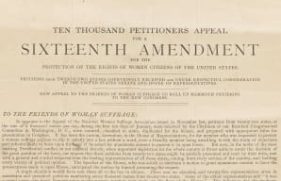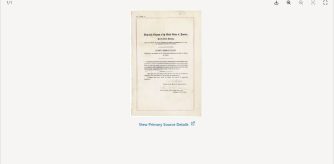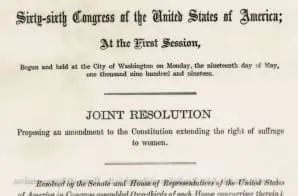
This document shows approval by both the House of Representatives and the Senate (by two-thirds vote in each house) of the proposed 19th amendment to the Constitution that “The right of citizens of the United States to vote shall not be denied or abridged by the United States or by any State on account of sex. Congress shall have power to enforce this article by appropriate legislation.”
Despite opposition from southern states, both houses of Congress passed the 19th Amendment, proposing full voting rights for women, and sent it to the states for ratification. Three-fourths of the states, or 36 states at that time, had to ratify the amendment before it could be added to the Constitution. On August 18, 1920, after calling a special session of the state legislature, Tennessee became the 36th state to ratify the 19th Amendment, thereby legally enfranchising one-half of the people.
The campaign for woman suffrage was long, difficult, and sometimes dramatic, yet ratification did not ensure full enfranchisement. Many women remained unable to vote long into the 20th century because of discriminatory state voting laws.
The document shown here is the Congressional joint resolution proposing the 19th Amendment. A joint resolution is a formal opinion adopted by both houses of the legislative branch. A constitutional amendment must be passed as a joint resolution before it is sent to the states for ratification.
The 19th Amendment is a part of America’s 100 Docs, an initiative of the National Archives Foundation in partnership with More Perfect that invites the American public to vote on 100 notable documents from the holdings of the National Archives. Visit 100docs.vote today.