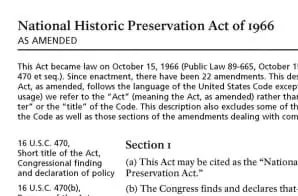
In 1966, Congress passed the National Historic Preservation Act, the most comprehensive preservation law in U.S. history. The previous year, President Lyndon B. Johnson had convened a special committee on historic preservation. The committee’s report to Congress, “With Heritage So Rich,” documented the need for preservation. At that time, the National Park Service’s Historic American Buildings Survey (HABS) had documented 12,000 places in the United States; but by 1966, half of them had either been destroyed or damaged.
According to the National Historic Preservation Act, any federal or federally funded project that will impact a historic structure or site must be reviewed to determine if the work might harm the site. Projects also have to follow federal preservation standards.
The new law also created the President’s Advisory Council on Historic Preservation and the National Register of Historic Places – an official list of important buildings and structures, districts, objects, and archeological sites. States are also required to take on responsibility for their historic sites, with each state establishing a historic preservation office and keeping an inventory of sites.