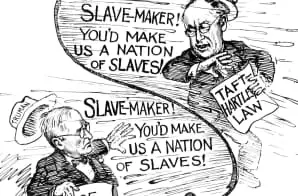
The Taft-Hartley Act, passed on June 23, 1947, covered several issues close to the labor debate, including giving employers the right to sue unions for breaking contracts and for damages resulting from labor strikes, and requiring an eighty-day “cooling off” period before unions were allowed to strike. President Harry S. Truman denounced the bill as the “slave-labor bill,” but Congress chose to override the President’s veto and enact the bill.
Meanwhile, Ohio senator Robert A. Taft opposed Truman’s initiative to institute price controls, by stating that price and wage controls did not allow businesses to make any profit.