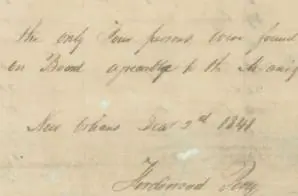
This manifest (list) shows 84 enslaved people who were shipped from Richmond, Virginia, aboard the brig Creole (a brig is a type of sailing ship), headed to New Orleans, Louisiana.
Only five of the enslaved people aboard the Creole made it to New Orleans, however, after a revolt aboard the ship. The Creole revolt is considered the most successful slave rebellion in U.S. history.
The Act Prohibiting the Importation of Slaves took effect in 1808, banning U.S. involvement in the international slave trade. (Notice the signed statement by the captains at the bottom of the first page attesting that the enslaved people had not been brought into the country after January 1, 1808.) Afterward, however, a domestic or “coastwise” trade persisted between ports within the United States. The brig Creole left Richmond in October 1841 with 135 people intended to be sold in New Orleans (see a second manifest with 51 names).
On November 7, 1841, Madison Washington – who had once escaped slavery to Canada but was recaptured after returning to Virginia for his wife – and 17 others led a revolt on the ship, killing one of the slave traders. (Frederick Douglass later published a work of fiction called The Heroic Slave based on Washington and the Creole revolt.) They took control of the ship and forced a crew member to navigate. They considered sailing to Liberia, in Africa, but didn’t have the supplies necessary to make the trip. Instead, they sailed to the Bahamas, a British colony.
Those aboard the Creole had heard about the fate of the enslaved people aboard the Hermosa the previous year, who had wrecked in the Bahamas and were set free. Because the Bahamas was subject to British law – where slavery was illegal – most of the enslaved people on the Creole were also considered free. Those who had led the revolt were temporarily jailed. The United States wanted to charge them with mutiny; however, under British law, they had the right to use force to escape illegal slavery, and were not charged. They were set free.
When the brig Creole arrived in New Orleans on December 2, 1841, only five enslaved people, who had remained in hiding on the ship while in the Bahamas, were aboard. Four of their names are listed on the back of this manifest: 24-year-old Rachel and her 9-year-old son Isah, 18-year-old Elizabeth, and 18-year-old Mary. (The fifth name is on the back of the second manifest.)
The Creole incident, among others in which British authorities freed people enslaved to Americans, led to tension between the United States and Great Britain at a time when they were negotiating the Webster-Ashburton Treaty.