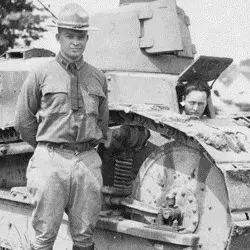
This is a photograph of Lieutenant Colonel Dwight D. Eisenhower standing in front of a tank at Fort Meade, Maryland. Eisenhower, a 28-year-old officer grown bored with his peacetime posting at Fort Meade, was one of the army observers on a 1919 Transcontinental Motor Convoy that toured the country along the Lincoln Highway, from Washington, DC, to San Francisco, California.
In the manner of the wilderness scouts of the 19th century, army personnel — mounting Harley-Davidsons instead of horses — ran ahead of the convoy to check out the conditions that lay just ahead. The vehicles broke down; got stuck in dust, quicksand, and mud; and sank when roads and bridges collapsed.
After 62 days, the convoy reached San Francisco. It had covered 3,251 miles, averaging 58 miles a day at an average speed of 6 miles an hour. The official report of the War Department, chronicling the 230 motor accidents of the convoy, concluded that the existing roads in the United States were “absolutely incapable of meeting the present day traffic requirements.”
The experience, which Eisenhower later described as “a genuine adventure” left a lifelong impression on him. When President 37 years later, he signed into law the Federal-Aid Highway Act of 1956, funding the National System of Interstate and Defense Highways which established more than 41,000 miles of superhighway.