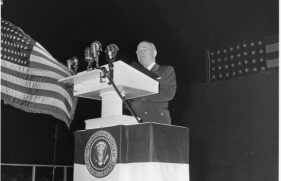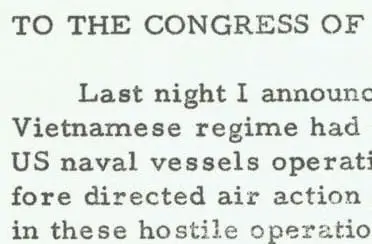
This is a message from President Lyndon Johnson to Congress, after the second incident in the Tonkin Gulf, in which he asks for a resolution on Southeast Asia.
Johnson portrayed confrontations between U.S. and North Vietnamese ships in the Gulf of Tonkin off the coast of North Vietnam as unprovoked aggression. With little debate, legislators passed the Tonkin Gulf Resolution, giving Johnson unprecedented power to “take all necessary measures to repel any armed attack against the forces of the United States and to prevent further aggression.”
The South Vietnamese regime in Saigon was in chaos after, 9 months earlier, a military coup had removed President Ngo Dinh Diem from office and he was assassinated. North Vietnam sharply escalated the war in hopes of bringing Communists to power before Americans fully intervened. Despite doubts about its significance and winnability, Johnson said he was “not going to lose Vietnam.”
When contrary information surfaced, many believed Congress had been conned. It was too late. Historians now suspect the North Vietnamese boats had set out to attack an ARVN raid in progress when it encountered the destroyer USS Maddox in the Gulf of Tonkin. The Maddox had been conducting electronic eavesdropping on North Vietnam to assist South Vietnamese Army (ARVN) commando raids on North Vietnamese targets.