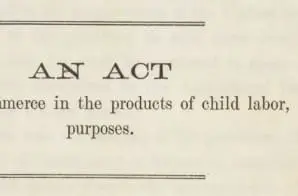
This act limited the working hours of children and forbade the interstate sale of goods produced by child labor. The Supreme Court later ruled it unconstitutional.
The 1900 census had revealed that approximately 2 million children were working in mills, mines, fields, factories, stores, and on city streets across the United States. The census report helped spark a national movement to end child labor in the United States.
In 1908, the National Child Labor Committee hired Lewis Hine as its staff photographer and sent him across the country to photograph and report on child labor. Social reformers began to condemn child labor because of its detrimental effect on the health and welfare of children.
This act was the first child labor bill. It was based on a 1906 proposal by Senator Albert J. Beveridge and used the government’s ability to regulate interstate commerce to regulate child labor. It banned the sale of products from any factory, shop, or cannery that employed children under the age of 14, from any mine that employed children under the age of 16, and from any facility that had children under the age of 16 work at night or for more than 8 hours during the day.
Although Congress passed the Keating-Owen Act and President Woodrow Wilson signed it into law, the Supreme Court ruled that it was unconstitutional in 1918 (in Hammer v. Dagenhar) because it overstepped the purpose of the government’s powers to regulate interstate commerce. In its opinion, the Court said the power to regulate production and commerce were two different things.
Congress passed another child labor bill in December 1918 as part of the Revenue Act of 1919 (also called the Child Labor Tax Law), this time citing the federal government’s power to levy taxes. In 1922, the Supreme Court found it too unconstitutional (Bailey v. Drexel Furniture Company). The Court reasoned that “The power of Congress to regulate interstate commerce does not extend to curbing the power of the states to regulate local trade.”
In 1924, Congress tried to regulate child labor through a constitutional amendment. The House of Representatives and Senate passed a joint resolution that was then submitted to the state legislatures for ratification. But the campaign for ratification was stalled by an effective campaign to discredit it. Opponents’ charges ranged from states’ rights arguments fearing increased federal power, to accusations that the amendment was a communist-inspired plot to subvert the Constitution. It fell short of the required three-fourths of states threshold needed to add it to the Constitution.
Congress finally obtained Federal protection for children in 1938, when it passed the Fair Labor Standards Act. The act prohibits “oppressive child labor” in the United States, which is defined, with exceptions, as the employment of youth under the age of 16 in any occupation or the employment of youth under 18 years old in hazardous occupations. The act was also challenged in the Supreme Court, but was upheld.