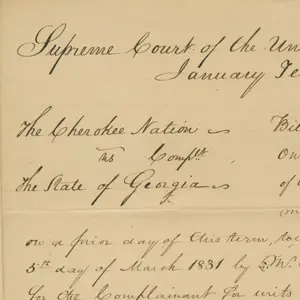
In 1828, the state of Georgia passed a series of acts taking away rights of Cherokees residing within the state, including Cherokee removal from land that the state wanted. The Cherokee asserted that Georgia did not have the jurisdiction or authority to do these things, since the Cherokee Nation was sovereign and protected under a treaty with the United States.
The Cherokee first tried to negotiate a resolution with President Andrew Jackson; but the negotiations fell apart quickly.
Under the leadership of principal chief John Ross, the Cherokee Nation sought an injunction — or order to stop what the State of Georgia was doing — from the U.S. Supreme Court.
This is the judgment denying the Cherokee Nation an injunction against Georgia laws, and dismissing their bill of complaints. The Supreme Court said they lacked jurisdiction to hear the case, and that an “Indian Nation” is not a “Foreign Nation” for jurisdiction under the Constitution, but instead a “domestic dependent nation.”
The case was dismissed, leaving the Cherokee at the mercy of the laws of the state of Georgia. The issue of “tribal sovereignty” would come up again in Worcester v. Georgia in 1832.
This document was digitized by teachers in our Primarily Teaching 2016 summer workshop in Washington, D.C.