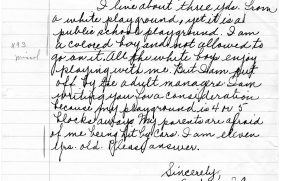
On May 17, 1954, in Brown v. Board of Education of Topeka (five separate cases consolidated under a single name), the U.S. Supreme Court ruled unanimously that separate but equal public schools violated the 14th Amendment.
On May 31, 1955 – one year and two weeks after the ruling that racial segregation in public schools was unconstitutional – Chief Justice Earl Warren issued this decree, ruling how desegregation was to be carried out. Known as Brown II, the decree directs that schools be desegregated under the control of Federal district judges “with all deliberate speed.”
Brown II was intended to work out the mechanics of desegregation. Due to the vagueness of the phrase “all deliberate speed” however, many states were able to stall the Court’s order to desegregate their schools. The legal and social obstacles that southern states put in place and encouraged, in their effort to thwart integration, served as a catalyst for the student protests that launched the Civil Rights Movement.